

I still remember my first Ugadi celebrations at Tirumala – the air thick with anticipation, the temple adorned with fresh mango leaves and vibrant flowers, and devotees streaming in with hearts full of devotion to welcome the Telugu New Year in the divine presence of Lord Venkateswara. That experience, now over fifteen years ago, marked the beginning of my annual pilgrimage to witness one of the most spiritually enriching festivals at the sacred hills of Tirumala.

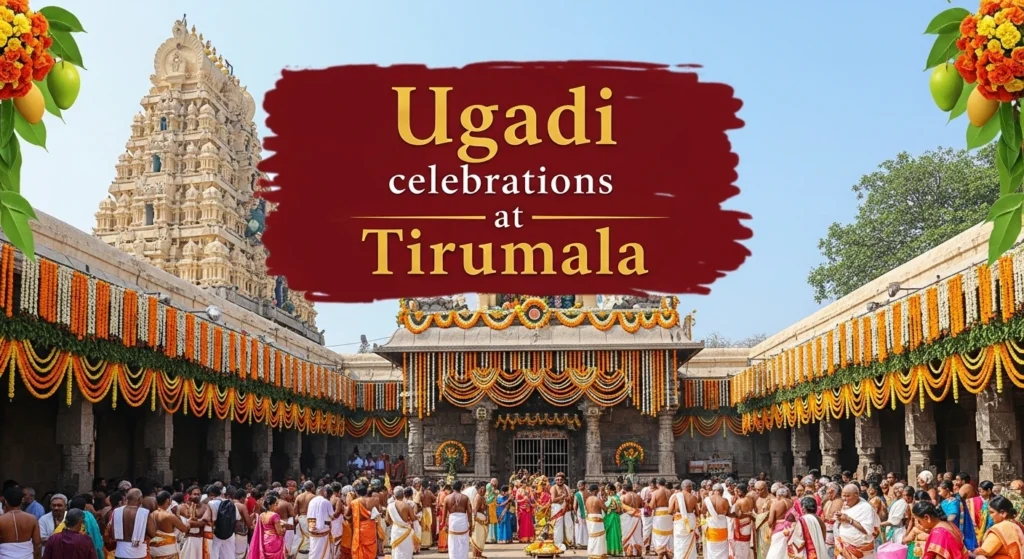
Ugadi, derived from the Sanskrit words “Yuga” (age) and “Adi” (beginning), signifies the beginning of a new year according to the lunar calendar followed in Karnataka, Andhra Pradesh, and Telangana. At Tirumala, this auspicious day transforms into a grand spiritual celebration, where ancient traditions merge seamlessly with devotional fervor. Having witnessed and participated in these celebrations numerous times, I’ve come to appreciate the depth of rituals and the significance of every offering made to the presiding deity.
The Spiritual Significance of Ugadi at Tirumala
Ugadi typically falls in March or April, marking the onset of spring – a season of renewal and rejuvenation. At Tirumala, the day holds special significance as it is believed that Lord Brahma, the creator, began his work of creation on this very day. The Tirumala Tirupati Devasthanams (TTD), which manages the temple, orchestrates elaborate arrangements to honor this sacred occasion.
During my visits, I’ve learned from temple priests and scholars that Ugadi at Tirumala isn’t just about celebrating a new year; it’s about spiritual renewal. It represents the opportunity for devotees to shed their past mistakes, seek divine blessings, and embark on a fresh spiritual journey. The temple witnesses an extraordinary influx of pilgrims – sometimes over 100,000 devotees in a single day – all eager to receive the Lord’s blessings on this auspicious day.
Pre-Ugadi Preparations: A Testament to Devotion
The preparations for Ugadi at Tirumala begin days in advance. Having had the privilege of observing these preparations during one of my extended stays, I can attest to the meticulous attention given to every detail. The temple complex undergoes thorough cleaning and decoration. Fresh mango leaves (toranalu) are hung at every entrance, symbolizing prosperity and good health. The pillared halls are adorned with colorful rangolis, traditional floral arrangements, and illuminated with countless oil lamps.
One aspect that particularly moved me was witnessing the sevaks (temple staff) working through the night before Ugadi, ensuring every corner of the temple gleamed with devotion. The Tirumala temple’s administrative efficiency is truly remarkable, coordinating thousands of volunteers and staff members to manage the festivities seamlessly.
The Ugadi Day Rituals: A Divine Schedule
Suprabhata Seva: The Divine Awakening
The Ugadi celebrations at Tirumala commence in the pre-dawn hours with the Suprabhata Seva, a ritual where the Lord is awakened with devotional songs and hymns. I was fortunate to participate in this seva during one of my visits, and the experience was transformative. The ancient verses of Annamacharya and Tallapaka Annamacharya’s compositions echo through the sanctum, creating an atmosphere of divine bliss.
The temple doors open around 2:30 AM, and the priests begin the Suprabhata Seva by 3:00 AM. According to Hindu temple traditions, waking the deity with devotional music is believed to please the Lord and set an auspicious tone for the day ahead.
Thomala Seva: The Floral Adornment
Following the Suprabhata Seva, the Thomala Seva takes place, where Lord Venkateswara is adorned with fragrant flowers. On Ugadi, this ritual assumes special significance with the use of seasonal flowers, particularly jasmine, marigold, and roses. The deity is decorated in a manner befitting the New Year, with priests spending hours creating intricate floral arrangements.
During one memorable Ugadi, I watched from the queue as the deity emerged for darshan after the Thomala Seva. The Lord appeared resplendent, adorned with thousands of flowers arranged in geometric patterns – a sight that brought tears to my eyes and reinforced my faith.
Abhishekam: The Sacred Bath
The Abhishekam, or sacred bathing ritual, is performed with great reverence on Ugadi. The deity is ceremonially bathed with various sacred substances including milk, yogurt, honey, ghee (panchamrita), followed by sacred waters, sandalwood paste, and finally pure water. Each substance has spiritual significance – milk represents purity, honey represents sweetness in life, and ghee symbolizes prosperity.
What fascinated me during my observations was learning that the abhishekam process follows Vedic traditions that have remained unchanged for centuries, maintaining the sanctity of these rituals through generations.
Archana and Special Poojas
Throughout Ugadi, special archanai (prayer services) and homams (fire rituals) are conducted. The temple priests perform Sahasranama Archana, where the thousand names of Lord Venkateswara are recited. Devotees can participate in these special poojas by making advance bookings through the TTD website.
I’ve personally participated in the Sahasranama Archana on three different Ugadi occasions, and each time, the vibrations of the sacred chants seemed to resonate deep within, creating a meditative state that lasted long after the ritual concluded.
Kalyanam: The Celestial Wedding
One of the highlights of Ugadi celebrations at Tirumala is the Kalyanam or celestial wedding ceremony of Lord Venkateswara with Goddess Padmavati. This elaborate ritual, performed in the afternoon, recreates the divine marriage with traditional customs. The deities are dressed in wedding attire, complete with jewelry and ornaments specifically reserved for this occasion.
Having witnessed this ceremony multiple times, I can confidently say it’s one of the most visually stunning and emotionally moving rituals at Tirumala. The priests conduct the ceremony following traditional Telugu wedding customs, complete with the exchange of garlands and the tying of the sacred thread (mangalsutra).
The Sacred Prasadam: Divine Offerings
Ugadi Pachadi: The Taste of Life
The most distinctive prasadam distributed during Ugadi at Tirumala is the Ugadi Pachadi – a unique preparation that symbolizes life’s various experiences. This special mixture combines six different tastes: sweet (jaggery), sour (tamarind), bitter (neem flowers), salty (salt), spicy (chili), and astringent (raw mango). Each taste represents a different emotion or experience in life.
The first time I tasted Ugadi Pachadi at Tirumala, I was unprepared for the explosion of flavors. But as the temple priest explained, accepting this prasadam with equanimity teaches us to accept all of life’s experiences – good and bad, pleasant and unpleasant – with the same grace. This philosophical teaching embedded in a simple prasadam left a lasting impression on me.
The TTD prepares thousands of packets of Ugadi Pachadi, distributed free to all devotees visiting the temple on this day. During my last visit, I learned from the kitchen staff that they begin preparations at midnight, ensuring the prasadam is fresh when distributed in the morning.
Tirumala Laddu: The Eternal Blessing
While Ugadi Pachadi is the special prasadam, the iconic Tirumala laddu remains an integral part of every darshan. On Ugadi, the laddu assumes additional significance as it represents the sweetness and prosperity of the new year ahead. Each devotee receives this sacred offering after darshan, blessed by the Lord himself.
I’ve collected laddus from various temples across India, but nothing compares to the Tirumala laddu – not just for its taste, which is divine, but for the spiritual energy it carries. The recipe, protected as a Geographical Indication (GI) tag, uses pure ghee, cashews, raisins, and cardamom, prepared with strict adherence to traditional methods.
Pulihora and Other Special Offerings
On Ugadi, devotees also receive pulihora (tamarind rice) as prasadam. This tangy rice preparation is considered highly auspicious and is believed to bring prosperity. The TTD kitchen, one of the largest temple kitchens in the world, prepares this in massive quantities using enormous vessels.
During one of my visits, I had the opportunity to observe the kitchen operations. The scale of preparation is staggering – hundreds of cooks working in perfect synchronization, preparing prasadam in quantities that could feed entire towns. Yet, the quality and taste remain consistently excellent, a testament to the devotion with which the work is performed.
Personal Experiences and Practical Tips
Planning Your Ugadi Visit
Based on my numerous visits to Tirumala during Ugadi, I cannot stress enough the importance of advance planning. The crowds during this festival are immense. Here are some practical tips I’ve learned over the years:
Accommodation Booking: Book your accommodation at least 2-3 months in advance. The TTD-operated guesthouses fill up quickly, but they offer the advantage of being close to the temple. I’ve stayed at both Madhavam and Sri Venkateswara Bhavan, both offering decent facilities at reasonable rates.
Darshan Tickets: Consider booking Sarva Darshan tickets online in advance. While free darshan is available, the wait times can extend to 12-20 hours during Ugadi. I learned this the hard way during my second visit when I spent an entire day in the queue. Special entry darshan tickets, though paid, can reduce wait times significantly.
Best Time to Visit: If you want to avoid the massive afternoon crowds, aim to reach the temple by early morning. My most peaceful Ugadi darshan was when I reached the queue by 4 AM. Yes, it meant sacrificing sleep, but the relatively shorter wait and the serene pre-dawn atmosphere made it worthwhile.
What to Carry: Carry a water bottle, some light snacks (though not allowed inside the main temple), and a fully charged phone. The queues have basic facilities, but having essentials makes the wait more comfortable.
Dress Code and Etiquette
Tirumala maintains a strict dress code. Men must wear dhoti or pant with shirt, while women should wear saree, salwar kameez, or traditional attire. Shorts, jeans, and short skirts are not permitted. During my early visits, I made the mistake of not carrying proper attire and had to rent clothes, which was inconvenient.
Exploring Beyond the Main Temple
While the main temple is the focal point, Ugadi is an excellent time to explore the spiritual ecosystem of Tirumala. I’ve visited the Sri Varaha Swami Temple, Bedi Anjaneya Swami Temple, and Sri Padmavathi Ammavari Temple in Tiruchanur during my trips. These smaller shrines offer their own unique spiritual experiences with fewer crowds.
The Hindu cultural practices at these temples provide deeper insights into the region’s rich religious heritage and complement the main temple experience beautifully.
The Spiritual Atmosphere: An Intangible Blessing
Beyond the tangible rituals and prasadam, what makes Ugadi at Tirumala truly special is the spiritual atmosphere. There’s an indescribable energy that permeates the hills during this festival. I’ve felt it during the early morning hours when thousands of devotees chant “Govinda Govinda” in unison while climbing the steps. I’ve felt it in the sanctum sanctorum when the priest performs the aarti, the flames dancing in rhythm with the ancient hymns.
One year, I met an elderly couple who had traveled from a remote village in Andhra Pradesh, their faces glowing with devotion despite the arduous journey. Their simple faith and genuine devotion reminded me why millions make this pilgrimage – it’s not just about ritual or tradition; it’s about connecting with something greater than ourselves.
The TTD’s Role in Preserving Traditions
The Tirumala Tirupati Devasthanams deserves commendation for maintaining these ancient traditions while accommodating modern crowds. The organization’s efforts in crowd management, maintaining hygiene standards, and ensuring every devotee receives prasadam regardless of the crowd size is remarkable.
During my interactions with TTD officials over the years, I’ve learned about the complex logistics involved. The temple management employs sophisticated crowd management systems, medical facilities, and volunteer coordination to ensure safety and spiritual fulfillment for all visitors.
The Ugadi Festival Beyond Tirumala
While experiencing Ugadi at Tirumala is extraordinary, the festival is celebrated with equal fervor across Andhra Pradesh, Telangana, and Karnataka. In homes, families prepare Ugadi Pachadi, new clothes are worn, and prayers are offered. The festival promotes values of renewal, gratitude, and acceptance of life’s dualities.
Understanding these broader cultural contexts enriches the Tirumala experience. I’ve made it a practice to visit local homes during my trips (whenever invited by fellow pilgrims I’ve befriended), witnessing how families celebrate Ugadi with traditional rituals, storytelling, and sharing meals.
Environmental Consciousness: A Modern Addition
In recent years, I’ve noticed increasing environmental consciousness during the celebrations. The TTD has implemented measures to reduce plastic usage, promote eco-friendly decorations, and manage waste effectively. As devotees, we too must contribute by being mindful of our environmental impact.
During my last visit, I participated in a voluntary clean-up drive organized by a group of young devotees. It was heartening to see spirituality and environmental responsibility merge seamlessly.
Conclusion: A Journey Worth Undertaking
Celebrating Ugadi at Tirumala is more than attending a festival; it’s a transformative spiritual journey. The rituals connect us to ancient traditions, the prasadam nourishes both body and soul, and the collective devotion of thousands creates an energy field that uplifts everyone present.
Whether you’re a first-time visitor or a regular pilgrim, each Ugadi at Tirumala offers new insights and deeper connections with the divine. The key is to approach it with an open heart, patience for the crowds, and reverence for the traditions.
As I plan my next Ugadi pilgrimage, I carry with me memories of past celebrations – the taste of Ugadi Pachadi reminding me of life’s completeness, the darshan of Lord Venkateswara renewing my faith, and the fellowship of fellow devotees reinforcing the unity that spirituality brings. I hope your Ugadi journey to Tirumala is equally blessed and memorable.
May Lord Venkateswara shower his choicest blessings on all devotees, and may the new year bring prosperity, health, and spiritual growth to everyone.
About the Author:
Smt. Rajeshwari Balaji is a dedicated traveler and Tirumala devotee with over 20 years of experience in organizing pilgrimages for families. Known for her practical advice and heartfelt narratives, she specializes in guiding first-time visitors through their spiritual journey. Her articles focus on everything from booking darshan tickets to finding comfortable accommodations and experiencing the sanctity of Tirumala. With personal anecdotes and detailed guides, she ensures readers have a smooth and fulfilling pilgrimage experience.
Email: rajeshwari.b@vidzone.in