
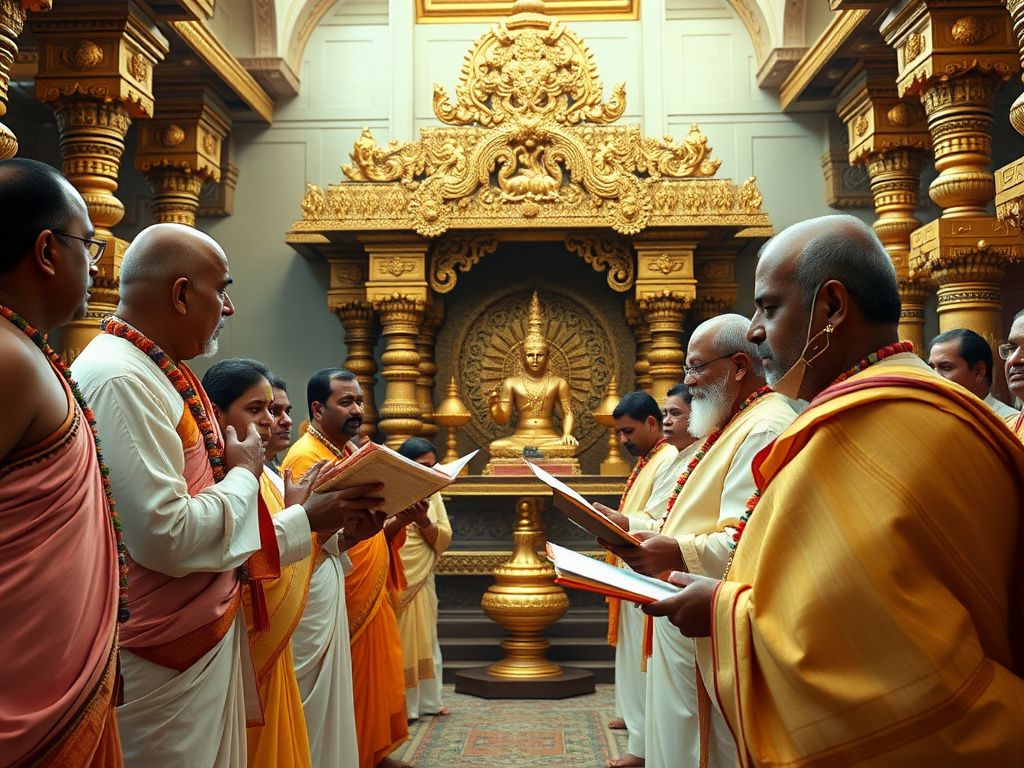
Sattumora is the formal closing recitation performed at Tirumala after major ritual cycles. The name comes from the Tamil words Satru (end, conclusion) and Murai (order, the proper way), giving the combined meaning “proper conclusion.” Adhyapakas (Vedic chanters) and trained Alwar singers deliver it in coordinated sequence, blending Sanskrit Vedic mantras with Tamil Pasuram verses from the Divya Prabandham. For pilgrims present at the right moment, it is often the most musically layered experience inside the temple complex.
In practice, most pilgrims encounter Sattumora as the closing segment after a sponsored Arjitha Seva rather than as a standalone event, because there is no separate Sattumora-only booking or ticket.
Table of Contents
What Sattumora involves
The ritual moves through a structured sequence each time it is performed:
- Specific Vedic mantras chanted by Adhyapakas with precise intonation
- Selected Pasuram verses from the Divya Prabandham sung by trained Alwar singers
- Formal honouring of the temple flag and emblems
- Annamacharya keertanas relevant to the ritual cycle’s theme
- Final aarti to the deity
- Prasadam distribution to attending devotees
The chant and song alternate between Sanskrit and Tamil, creating a sonic structure that connects the two great streams of South Indian devotional literature. Both performer groups are TTD-employed temple staff, trained in their respective traditions for years before being permitted to lead the Sattumora.
When Sattumora is performed
Sattumora occurs at multiple points across the daily and festival calendar:
- Daily Sattumora: at the end of major daily ritual sessions, including after Tomala, after Archana, and after Kalyanotsavam
- Weekly Sattumora: particularly significant on Fridays, following the Abhishekam
- Festival Sattumora: closes festival-day events such as Brahmotsavam day vahanas and the Vaikuntha Ekadasi observance
- Arjitha Seva conclusion: any sponsored Arjitha Seva ends with a Sattumora as its formal closing
Pilgrims planning around specific rituals can confirm current daily schedules at tirumala.org.
The two performer groups
Sattumora depends on two distinct groups of specialist staff working in sequence:
Adhyapakas
Vedic scholars trained in Sanskrit ritual chanting. They recite prescribed Vedic mantras with the exact intonation required by Agama tradition. This is not congregational chanting; it is a precise, trained delivery that takes years to master.
Divya Prabandham singers
Tamil-trained singers who recite Pasuram verses from the compositions of the Twelve Alwars. The Divya Prabandham is the canonical body of Tamil Vaishnava devotional poetry, and the singers are trained specifically in the rendering styles appropriate for temple ritual.
Together these two groups represent Tirumala’s synthesis of the Sanskrit Vedic and Tamil Alwar bhakti traditions, a combination that defines Sri Vaishnava temple worship and is most fully developed here.
Significance of the closing recitation
Sattumora serves a precise ritual purpose, not simply an aesthetic one. It formally closes the worship cycle, ensuring the ceremony is not left incomplete. Leaving a ritual cycle open is considered inauspicious in Agama practice, so the Sattumora acts as the liturgical full stop.
Beyond its structural role, Sattumora also:
- Acknowledges the lord’s acceptance of the day’s worship
- Distributes the accumulated blessings of the completed cycle to attending devotees
- Maintains the unbroken ritual continuity that defines Tirumala’s worship tradition
Details on specific Arjitha Seva packages that include Sattumora can be checked on ttdsevaonline.com.
How pilgrims experience Sattumora
For a visiting pilgrim, Sattumora is most often encountered in one of four ways:
- The closing sequence after a sponsored Arjitha Seva the family has booked
- Recitation heard from within the temple queue during normal darshan
- The chanting and music that forms the ambient devotional soundscape of the inner temple
- The final prasadam moment before exiting the inner sanctum area
To set expectations: there is no timed visitor slot for Sattumora alone. Access depends on being present inside the temple during the relevant ritual, either through a booked seva or through the general darshan queue.
Pilgrims travelling from outside Andhra Pradesh can plan transport through irctc.co.in for trains or apsrtconline.in for buses to Tirupati, with the ghat road ascent to Tirumala available by TTD bus or private vehicle from there.
The Pasuram and Veda integration
Tirumala is one of the few temples that integrates both Sanskrit Vedic mantra and Tamil Alwar Pasuram into its daily mandatory ritual structure. This is not occasional or ceremonial; it happens every day across every ritual cycle. The Sattumora is where this integration is most audibly present, with the Sanskrit chant and Tamil song alternating in a defined liturgical order.
This dual tradition is a distinctive feature of Sri Vaishnava temples rooted in the Pancharatra and Vaikhanasa Agamas. At Tirumala, the tradition has been maintained without interruption, making the Sattumora one of the oldest continuously performed closing recitation forms in South Indian temple practice.
Common questions
Is there a separate Sattumora ticket or booking? No. Sattumora is the closing segment of other ritual cycles. Sponsoring an Arjitha Seva includes its concluding Sattumora; there is no standalone Sattumora booking.
Can pilgrims attend only the Sattumora? There is no Sattumora-only access. Pilgrims inside the temple during normal darshan or after a booked seva can hear and witness it, but it cannot be attended as a separate programme.
What languages are used in the Sattumora? Sanskrit for the Vedic mantras chanted by Adhyapakas, and Tamil for the Alwar Pasuram verses sung by Divya Prabandham singers. No translation or commentary is provided during the recitation.
Which Arjitha Sevas end with a Sattumora? Any sponsored Arjitha Seva includes a formal Sattumora at its conclusion. This applies to sevas such as Kalyanotsavam, Suprabhata Seva, and others offered through the TTD seva system.
Does Sattumora happen every day? Yes. Daily Sattumoras follow the major daily ritual sessions, including after Tomala, after Archana, and after Kalyanotsavam. The Friday Sattumora after Abhishekam is considered especially significant.
Who are the Adhyapakas? Adhyapakas are TTD-employed Vedic scholars trained specifically in Sanskrit ritual chanting. They undergo years of training in precise intonation before performing within the temple ritual structure.
What is the Divya Prabandham? The Divya Prabandham is the collection of Tamil devotional hymns composed by the Twelve Alwars, the Vaishnava poet-saints. At Tirumala, trained singers deliver selected Pasuram verses from this collection as part of the Sattumora and other daily rituals.
Related reading
- Koluvu or Durbar at Tirumala: Details and Importance
- Kalyanotsavam Seva Booking and Cost
- Suprabhata Seva: Details and Booking Procedure
- Sahasra Deepalankarana Seva: Details and Booking
- Ekantha Seva at Tirumala
- Unjala (Dolotsavam) Seva: Timings and Booking

1 comment
I need darshan ticket