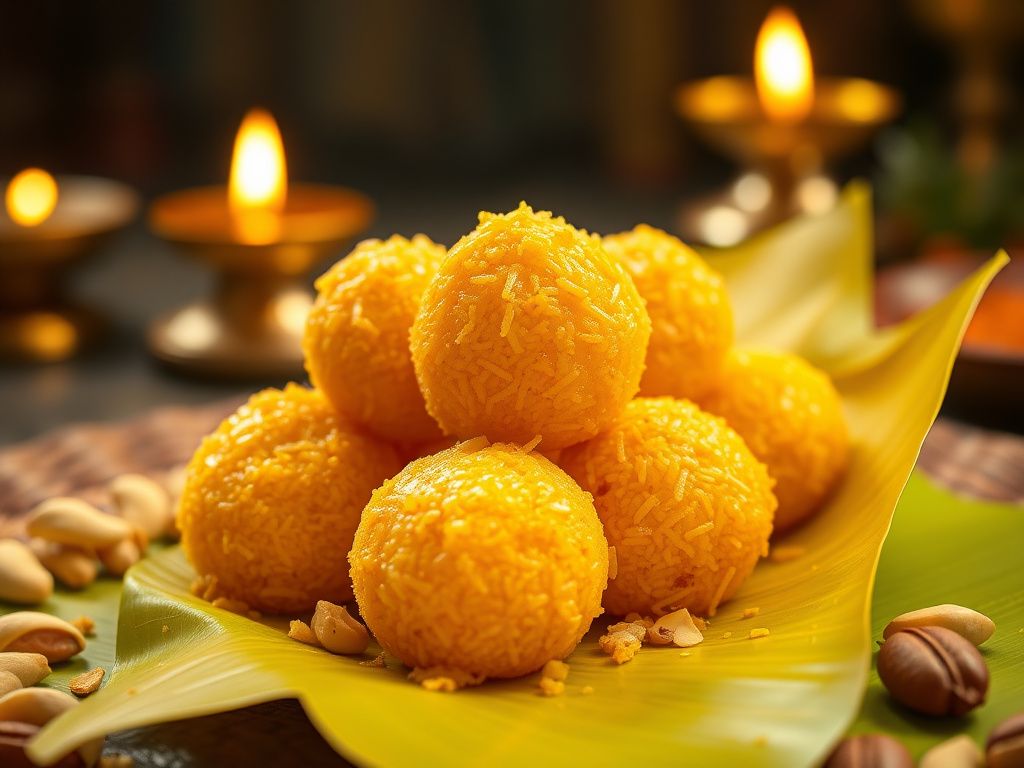
The Tirumala Srivari Laddu is the most recognised temple prasadam in India, a ghee-soaked sphere of boondi studded with cashews and raisins that millions of pilgrims carry home from Tirumala every year. It is also far more than a sweet: a documented 311-year tradition, a tightly controlled recipe made only inside the temple’s Potu kitchen, and one of the few foods in the country protected by a Geographical Indication tag. Here is where it came from, how it is actually made, and why the law treats it as one of a kind.
Table of Contents
When the laddu tradition began
The Srivari Laddu in its present form was first offered as Tirumala prasadam on 2 August 1715, a date TTD records mark as the formal start of laddu distribution as the temple’s principal prasadam. The lineage runs older still. Temple records from the Vijayanagara period in the 1480s describe a sweet called manoharam, made from similar ingredients, that is considered the laddu’s direct ancestor. The scale has grown enormously over three centuries while the core recipe stayed remarkably constant. Early batches were cooked over firewood; in 1984 TTD switched the Potu to LPG, which improved both consistency and output.
Inside the Potu, where every laddu is made
The sanctified kitchen inside the temple complex is the Potu, and the recipe followed there is the dittam, a fixed traditional formula handed down through generations of temple cooks. Nothing labelled a Tirumala laddu is made anywhere else.
Daily output
- Normal days: around 1,50,000 laddus.
- Festival peaks such as Brahmotsavam and Vaikunta Ekadasi: up to 8,00,000 in a single day.
What goes in each day
- About 10 tons of besan (gram flour)
- 300 to 500 litres of pure ghee
- 700 kg of cashew nuts
- 540 kg of raisins
- 150 kg of green cardamom
- 500 kg of sugar candy and granulated sugar
Every ingredient is TTD-procured under quality control, with ghee drawn from authenticated dairies and gram flour milled fresh.
The dittam, step by step
- Boondi: besan and water are mixed to a set consistency and dropped through a perforated ladle into hot ghee, forming the small round droplets.
- Syrup: sugar candy is dissolved to traditional ratios, then cardamom and dry fruits are added.
- Mixing: the boondi is soaked in warm syrup and rolled by hand into spheres.
- Inspection: each batch is quality-checked before it reaches the counters.
Conveyor belts carry ingredients in and finished laddus out, and the kitchen works almost continuously.
Why it carries a GI tag
In 2009 the Government of India granted the Tirumala Srivari Laddu a Geographical Indication under the GI Act of 1999. That protection makes the name itself legally restricted: only laddus made in the temple’s official Potu may be sold as Tirumala Laddu, and anything sold elsewhere under that name violates the tag. The GI recognises the regional sourcing of ingredients, the specific dittam refined over three centuries, the single permitted production location, and the unbroken history of the laddu as a temple prasadam.
How devotees receive it
- Free with darshan: every Sarva Darshan and Special Entry Darshan ticket includes two small laddus per devotee.
- Extra laddus: sold at counters around the temple, with the rate set at the counter.
- Large laddus: reserved for certain sevas and donations.
- Tirupati counters: limited stock at the railway station and bus stand for pilgrims who could not reach the hill.
For what it’s worth, the extra laddus are worth buying even if you already have your free two. They keep for about a week, they travel well, and the Potu texture is genuinely hard to find in any shop outside the temple.
Why it resists home recreation
The ingredients are ordinary enough, gram flour, ghee, sugar and dry fruit, yet home versions rarely match the taste. The reasons are the precise dittam ratios calibrated over 300 years, the specific grade of TTD-sourced ghee and flour, and a preparation method that lives with the Potu cooks rather than in any printed recipe.
One honest limitation: I cannot quote you a fixed per-laddu counter price here, because TTD revises it from time to time. Check the current rate at the counter rather than trusting a number from any third-party site.
Common questions
How long does a laddu stay fresh? Kept at room temperature it holds for about 7 to 10 days, and refrigerated it lasts up to roughly three weeks.
Can I order it online? TTD has piloted online laddu ordering; check the current status on the official portal. Third-party delivery services are not endorsed by TTD.
Are there different sizes? Yes. The small laddu is the one distributed free with darshan, while larger laddus are tied to sevas and donation slabs.
Is it vegetarian? Yes, strictly. It uses pure ghee, gram flour, sugar, cardamom, cashews and raisins, with no animal products.
What other prasadam can I get? Pulihora, daddojanam (curd rice), vada, pongal and boondi are distributed at various sevas.
Related reading
- Tirumala TTD laddu: the popular Srivari prasadam
- Sri Venkateswara Anna Prasadam Trust
- Tirumala daily sevas and how to book them
For current laddu pricing and live updates, check the official portal at ttdevasthanams.ap.gov.in and news.tirumala.org.