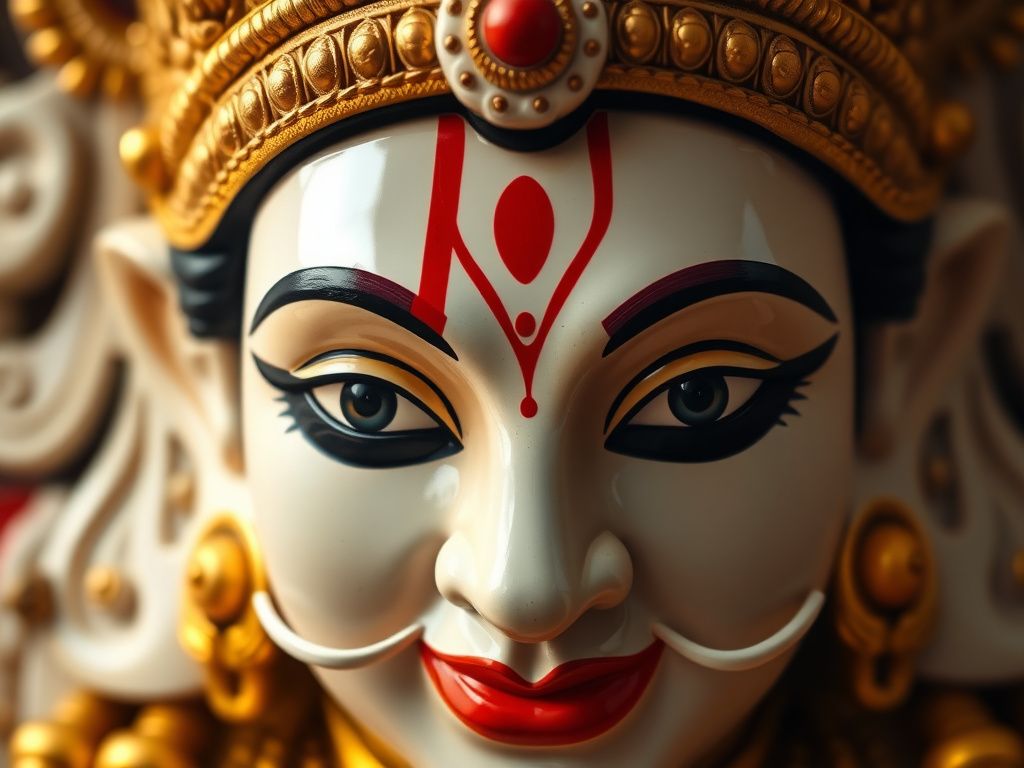
Look closely at the Tirumala deity and you notice that the Lord’s eyes appear largely covered by the temple’s distinctive white namam. It is one of the most frequently asked questions in Tirumala tradition: why are Lord Venkateswara’s eyes covered? The traditional answer ties to the immense power believed to reside in the Lord’s direct gaze. This article explains the tradition, the significance of the namam, and the one day of the week when devotees can see the fuller form, all as the temple’s own accounts describe it.
Table of Contents
The Tirumala namam
The Lord at Tirumala wears a prominent white namam, shaped in the Vaishnava U or Y form with a central line of contrasting colour. It is applied across the forehead and extends down so that it covers a significant portion of the eyes, leaving only the lower part visible. That heavy, eye-covering namam is one of the defining visual features of the Tirumala deity, instantly recognisable to anyone who has had darshan.
The traditional explanation: the power of the gaze
According to Tirumala tradition, the eyes of Lord Venkateswara radiate such intense divine energy that a full, direct gaze is considered too powerful for ordinary devotees to bear. The namam over the eyes is said to moderate that power, letting devotees stand before the Lord and receive His grace without being overwhelmed. One account holds that when the gaze is fully revealed on special occasions, devotees feel an overwhelming surge of emotion, which is why the eyes are only fully visible at certain rare moments in the ritual cycle.
When the fuller form is revealed
The namam is reduced or repositioned during specific rituals, most notably the Friday Abhishekam, when the deity is bathed and the original form is revealed before the namam is re-applied. This is the Nija Roopa Darshanam, the darshan of the true form. On Fridays, devotees with the appropriate darshan can see the Lord’s face and eyes more fully than on any other day, which is a large part of why Friday darshan at Tirumala is held to be especially auspicious.
For what it’s worth, if this tradition is what draws you, time your trip for a Friday and book ahead. The fuller-form darshan after the Abhishekam is the one occasion the namam is reduced, and it is worth the harder-to-get Friday slot rather than leaving it to chance on a random weekday.
What it means for devotees
- The covered eyes symbolise the controlled, compassionate way the Lord shares infinite power with finite beings.
- They reflect the principle that grace is given in a measure devotees can actually receive.
- The Friday revelation of the fuller form is treated as a special blessing.
- The namam itself is a sacred mark, and its substances are considered holy.
Tradition, not a literal claim
These explanations belong to the Sthala Purana and the living oral tradition of Tirumala. They are part of the temple’s sacred narrative, passed down through generations, and devotees experience them as profound spiritual truth. They are set out here as the temple tradition rather than as scientific statements, which is the honest way to hold them.
Common questions
Are the Lord’s eyes ever fully visible? The fuller form, including the eyes, is revealed during specific rituals such as the Friday Abhishekam, before the namam is re-applied.
Why is Friday darshan special? The Friday Abhishekam reveals the Lord’s original form, the Nija Roopa Darshanam, more fully, which devotees consider especially blessed.
What is the namam made of? The white namam is traditionally made from refined camphor (pachha karpooram) and sacred substances, with a central line of a contrasting colour.
Is the eye-covering namam unique to Tirumala? The prominent, eye-covering namam is a distinctive feature of the Tirumala Venkateswara deity, closely tied to this temple’s tradition.
Is this history or belief? It is part of Tirumala’s sacred tradition and devotional understanding, not a scientific claim, and is presented here as the temple’s living narrative.
Related reading
- The Sthala Puranam of Tirumala
- Tirumala daily sevas and how to book them
- Who was Vakula Matha, and her significance
One honest caveat: what you actually see depends on your darshan type and the day’s timing, and the extent of the namam is set by the temple, not by visitors, so treat the Friday revelation as the tradition describes it rather than a guaranteed close-up. For authoritative accounts, see tirumala.org and news.tirumala.org.