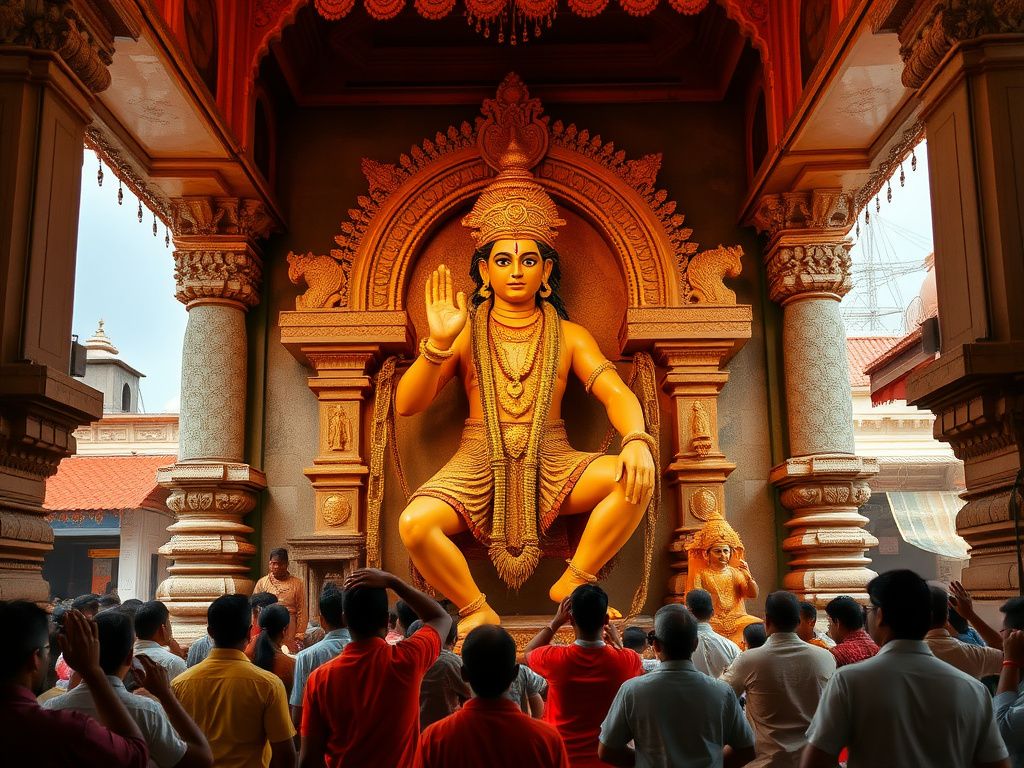
Directly opposite the main entrance of the Sri Venkateswara temple at Tirumala stands a shrine that most pilgrims pass twice: once entering and once leaving. The Sri Bedi Anjaneya Swamy Temple is dedicated to Lord Hanuman in a form unlike the fierce, mountain-lifting images common elsewhere. Here he is depicted with his hands bound, a tender and unusual form that carries a legend of maternal love and childhood mischief.
Table of Contents
The legend of the bonds
According to tradition, the young Hanuman, called Anjaneya after his mother Anjana Devi, was extraordinarily restless. His immense strength as a divine child made him difficult to contain: he would wander, play, and exercise his powers in ways that caused havoc around him. Anjana Devi, out of a mother’s practical love, tied his hands with bonds to keep the spirited child from going too far.
This is the form enshrined at Tirumala: not the invincible devotee who carries mountains, but the energetic divine child lovingly restrained by his mother. It is a human, intimate image of a figure usually portrayed in his full heroic power. The name Bedi Anjaneya reflects this directly: bedi means bonds or chains, and Anjaneya is one of Hanuman’s names, meaning son of Anjana Devi.
Location and its significance
The placement of this shrine is deliberate and meaningful. Bedi Anjaneya stands directly opposite the main Sri Venkateswara temple, with Hanuman’s gaze always on the Lord. This arrangement embodies a central idea in the Ramayana-derived devotional tradition: Hanuman is the supreme devotee, whose entire existence is oriented toward his Lord. Even in his bound, childhood form, he faces the temple, serving and adoring.
Pilgrims moving toward the main temple naturally pass Bedi Anjaneya on their way in; many stop to offer prayers, seeking Hanuman’s strength and protection before approaching the Lord. On the way out, after darshan, another pause here completes a natural circuit of devotion. The positioning makes the shrine almost impossible to miss, and it rewards that attention.
- Location: Directly opposite the main Sri Venkateswara temple, facing the Lord’s sanctum
- Significance: Hanuman in eternal darshan of Lord Venkateswara, whom he serves
- Connection to Anjanadri: Hanuman’s birthplace is traditionally identified as the Anjanadri hill of the Tirumala Saptagiri
- Devotional purpose: Pilgrims seek strength, protection, and the removal of obstacles
Why Hanuman faces the Lord
In the theological geography of Tirumala, the placement of Bedi Anjaneya is not accidental. Hanuman is, in the Vaishnava tradition, the model devotee: completely surrendered, constantly in service, finding his entire meaning in proximity to the Lord. By facing the Sri Venkateswara temple, he is positioned in permanent darshan of the deity he serves. He is not a subsidiary figure facing outward to protect the temple; he faces inward, toward the Lord.
This makes the shrine a teaching as much as a place of worship. Every pilgrim who pauses here and looks at Hanuman looking at the temple is seeing the image of ideal devotion: bound, small, a child, and yet fully present before the Lord he loves.
Worship and special days
Devotees bring traditional offerings to Bedi Anjaneya: betel-leaf garlands are particularly associated with Hanuman worship, along with vada malas (garlands of lentil fritters) in some regional traditions. Saturdays and Tuesdays are the days most traditionally associated with Hanuman across India, and the shrine sees heightened activity on these days.
Hanuman Jayanti, the celebration of Hanuman’s birth, is observed with special significance at this shrine. The connection to Anjanadri hill, where the Tirumala tradition locates Hanuman’s birth, gives the Jayanti observance at Tirumala a particular depth: the hill, the shrine, and the festival are all part of the same sacred geography.
In practice, the brief stop at Bedi Anjaneya on the way into the main temple area adds only a few minutes but changes the quality of the whole visit, giving it a more complete and sequential feel.
A fair warning: specific puja timings and the schedule of special observances at Bedi Anjaneya are managed by TTD and can vary; check tirumala.org or news.tirumala.org for current information before planning around particular dates.
Common questions
Why is he called Bedi Anjaneya? Bedi means bonds or chains; the deity is depicted with bound hands, reflecting the legend of Anjana Devi restraining her energetic divine child.
Where exactly is the temple? Directly opposite the main entrance of the Sri Venkateswara temple at Tirumala, facing the Lord’s sanctum.
Why does Hanuman face the main temple? As the supreme devotee, Hanuman’s existence is oriented toward his Lord. The placement enacts his eternal darshan and service of Lord Venkateswara.
Which days are best for worshipping Hanuman here? Saturdays and Tuesdays are traditionally associated with Hanuman; Hanuman Jayanti has special significance at this shrine.
Is this connected to Anjanadri hill? Yes. Hanuman’s birthplace is traditionally identified as the Anjanadri hill, one of the Saptagiri of Tirumala, giving the shrine a direct geographical connection to his origin.
What offerings are traditional here? Betel-leaf garlands are particularly associated with this shrine; other traditional Hanuman offerings vary by regional practice.
Related reading
- Anjanadri — Birthplace of Hanuman
- Hanumantha Vahanam — Day 6 of Brahmotsavam
- 10 Secret Sacred Sites in Tirumala