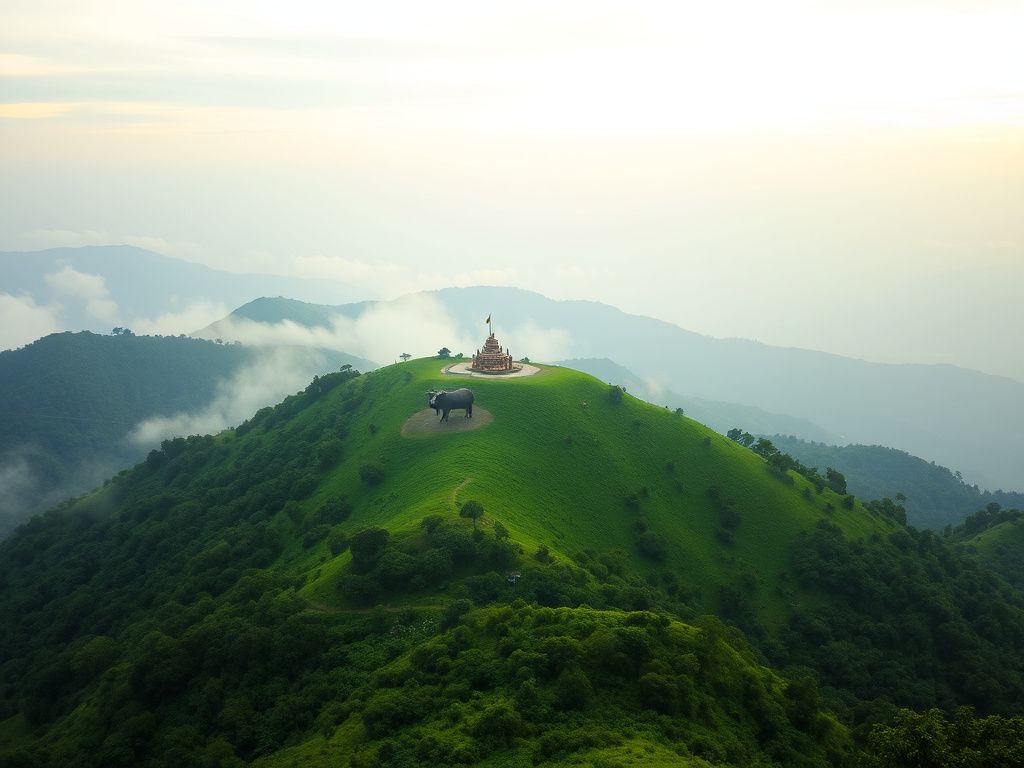
Among the seven sacred hills of Tirumala, each carries its own legend and its own name. Vrishabhadri is named after a divine bull, Vrishabha, who is said to have performed penance on this hill in devotion to the Lord. The story is brief in its telling but significant in what it represents: another being, from another species and tradition, drawn to Tirumala’s hills through the same impulse of devotion that brings millions of human pilgrims today.
Table of Contents
The name Vrishabhadri
Vrishabhadri is a compound of two Sanskrit words: Vrishabha (bull) and adri (hill). The hill of the bull. The bull holds layered significance across Hindu tradition. As Nandi, the divine bull is the vehicle and gatekeeper of Lord Shiva, eternally stationed at Shiva’s threshold in unwavering devotion. The bull also symbolises dharma itself: in the Satya Yuga, dharma is described as standing on all four legs; in each subsequent age, it loses one. The bull, by nature, embodies steady and patient strength.
Naming this hill after Vrishabha connects it to these traditions of devoted service and dharmic steadiness, qualities that define the character of Tirumala’s sacred landscape as a whole.
The legend
According to tradition, a divine bull named Vrishabha came to this hill and performed intense penance (tapas) in devotion to the Lord. Pleased with the sincerity and duration of the bull’s austerity, the Lord granted a boon: the hill would carry the bull’s name for all time. This is the essential shape of the Vrishabhadri legend, and it echoes a pattern found across the Saptagiri.
Each of the seven hills has become sacred through the penance or presence of a different divine being. Anjanadri is the hill where Anjana Devi gave birth to Hanuman after her own penance. Venkatadri holds the Lord’s sanctum, chosen by the Lord himself. Vrishabhadri was consecrated by a bull’s devotion. The cumulative effect of these legends is a mountain range understood not as geology but as the accumulated spiritual weight of countless acts of devotion across time.
Significance within the Saptagiri
The Saptagiri, the seven sacred hills, are understood in the Tirumala tradition as the physical form of Adisesha, the cosmic divine serpent on whom Lord Vishnu reclines in the primordial ocean. Each hill is a coil of Adisesha’s body, and worshipping the hills is inseparable from worshipping the Lord who rests upon that divine serpent.
Vrishabhadri’s place in this sacred body matters because it contributes to the wholeness of the seven. No single hill stands alone; each is part of a form larger than itself.
- Each of the seven hills carries a legend of penance or divine association
- Vrishabhadri represents devoted service expressed through the symbolism of the bull and dharma
- The collective sanctity of all seven hills makes Tirumala a uniquely layered sacred place
- Together, the hills are understood as the form of Adisesha
The seven hills together
Vrishabhadri is counted among the Saptagiri alongside Venkatadri (the principal hill, holding the main sanctum), Anjanadri (Hanuman’s birthplace), Garudadri, Narayanadri, Seshadri, and Neeladri. The specific names and their assignment to particular peaks can vary across different Puranic accounts, but the number seven and the overall sacred identity of the range are consistent across the tradition.
Pilgrims who walk the Srivari Mettu or Alipiri paths to Tirumala are passing through this sacred range on foot, and that passage is itself an act of worship. Understanding that each hill carries its own legend adds depth to what might otherwise feel like a long, demanding climb.
My own take: of all the Saptagiri legends, Vrishabhadri’s is the most quietly democratic. A bull performs penance, the Lord is pleased, a hill gets a name. It requires no heroic lineage or celestial origin, only sustained devotion. That is a story pilgrims of any background can sit with.
One limitation to be straight about: the specific Puranic sources for the Vrishabhadri legend and the precise identification of which physical peak bears this name are not universally agreed upon across all texts. For detailed and authoritative accounts, the TTD’s own publications, available through tirumala.org, are the most reliable starting point.
Common questions
What does Vrishabhadri mean? The hill of the bull: Vrishabha (bull) combined with adri (hill).
What is the legend of Vrishabhadri? A divine bull named Vrishabha performed penance on this hill; the Lord was pleased and granted that the hill would carry the bull’s name permanently.
Is the bull connected to Shiva? The bull (Nandi) is indeed Shiva’s vehicle and emblem of dharma; the legend of a bull performing devotional penance draws on these associations, reflecting the cross-traditional devotion that converges at Tirumala.
Is Vrishabhadri one of the seven sacred hills? Yes. It is counted among the Saptagiri of Tirumala.
Can pilgrims visit Vrishabhadri separately? The hills form a continuous range within the protected Seshachalam forest; the Tirumala temple town sits on Venkatadri. Separate access to individual peaks is not available to general pilgrims; confirm current access arrangements on tirumala.org.
Why do the seven hills matter as a group? Taken together, they are understood as the form of Adisesha, and their collective sacred identity makes the entire Tirumala plateau, not just the main sanctum, a place of worship.
Related reading
- Saptagiri: The Seven Sacred Hills of Tirumala
- Venkatadri: The Principal Sacred Hill
- Anjanadri: Birthplace of Hanuman