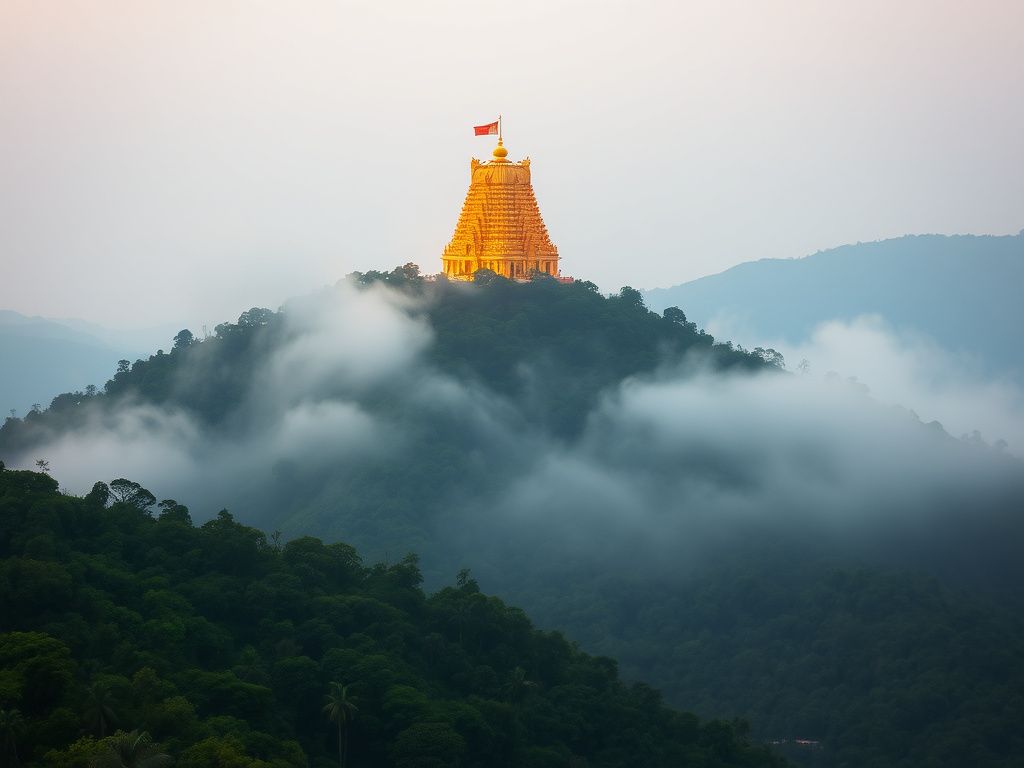
Of the seven sacred hills that form the Saptagiri at Tirumala, Venkatadri holds a place apart. It is the hill that shelters the sanctum of Lord Venkateswara himself, and the Lord takes His very name from it: Venkateswara means the Lord (Iswara) of Venkata. Understanding Venkatadri, its name, its elevation, its place in the Saptagiri, reveals why the hill itself is venerated as inseparable from the deity who lives upon it.
Table of Contents
The meaning of Venkata
The name Venkata is traditionally interpreted as the destroyer of sins. One popular etymology breaks the word into two parts: Ven (sins) and kata (the power that burns or destroys). Put together, Venkata names the hill that burns away the accumulated karma of those who approach it. This is not incidental: the very geography of Tirumala is understood, in the devotional tradition, as an instrument of liberation. The hill does not merely hold the temple; it participates in the act of purification.
From this root comes Venkateswara: Venkata + Iswara, the Lord of the sin-destroying hill. Every time the name is spoken, a pilgrim is invoking both the deity and the sacred landscape from which He is inseparable.
The hill that holds the Lord
Venkatadri rises to approximately 853 metres (about 2,800 feet) above sea level. On its plateau sits the Sri Venkateswara temple, the Swami Pushkarini (the sacred tank used for ritual bathing and ablutions), and the entire Tirumala township that has grown to serve the millions who visit each year. These are not separate things placed on a convenient hill; in the devotional understanding, the hill is the foundation that the Lord chose, and the Pushkarini, the temple, and the town all exist in relation to that original choice.
The significance flows in both directions. The hill sanctifies everything on it, and the Lord’s presence sanctifies the hill further. This mutual consecration is why Venkatadri is treated not as real estate but as a living sacred presence.
Why the hill itself is sacred
In the Tirumala tradition, the Saptagiri as a whole is understood to represent the form of Adisesha, the cosmic divine serpent upon whom Lord Vishnu reclines in the celestial ocean. Each of the seven hills is a coil of Adisesha’s body. Venkatadri, holding the Lord’s sanctum, is the central and most sacred coil.
This understanding has practical consequences for pilgrims. Traditional practice holds that one should not wear footwear beyond certain points on the hill, because the ground itself is considered part of the divine form. Climbing the hill on foot via the ancient pathways (the Alipiri or Srivari Mettu routes) is treated as a sacred act, not simply a physical journey. Even placing one’s feet on the hill is considered purifying, and the difficulty of the climb is understood as a fitting offering of effort and devotion.
The way I see it, this theology of sacred geography is one of the most spiritually coherent aspects of Tirumala pilgrimage: the journey to the deity is itself a form of worship, because the path and the ground are part of the divine body.
Venkateswara: the Lord of Venkatadri
The Lord is known by many names, each illuminating a different aspect of His nature. Srinivasa means the abode of Sri (Lakshmi), pointing to His role as the consort of the goddess. Balaji is the name most commonly used across North India and Maharashtra. Govinda, chanted in the famous Govinda Nama Saptaha, links Him to His aspect as the protector of cows and the world. Edukondalavada means the Lord of the Seven Hills, locating Him in the specific geography of Tirumala.
But Venkateswara is unique among these names because it directly binds the deity to the hill. He is not the Lord who happens to live on Venkatadri; He is the Lord of Venkatadri, the hill that destroys sin. The name itself carries the theology of liberation that pilgrims seek when they make the long journey to Tirumala.
What pilgrims carry from this understanding
Knowing the meaning of Venkatadri changes how a pilgrim experiences the journey. The ghat road, the foot paths, the first glimpse of the gopuram from the hilltop: each of these is a step further into the divine form of Adisesha, drawing closer to the Lord who has chosen this hill as His eternal abode. The tiredness of the climb, the heat, the crowds: none of these are obstacles but part of the offering.
One honest caveat: the specific Puranic accounts of Venkatadri vary across different texts and traditions; for an authoritative and detailed account, the publications of the Tirumala Tirupati Devasthanams (available through tirumala.org) are the most reliable source.
Common questions
What does Venkata mean? The destroyer of sins: Ven (sins) + kata (the power that burns them away). The name captures the hill’s spiritual purpose.
Why is the Lord called Venkateswara? Venkata + Iswara equals the Lord of the sin-destroying hill. The name ties the deity directly to the sacred geography of Tirumala.
How high is Venkatadri? Approximately 853 metres above sea level, which is about 2,800 feet.
Is the hill itself worshipped? Yes. The hill is understood to be part of the divine form of Adisesha, the cosmic serpent, and is treated with reverence equal to that given to the deity.
What other names does the Lord carry? Srinivasa, Balaji, Govinda, and Edukondalavada are among the most widely used, each pointing to a different facet of the same Lord.
Why do pilgrims walk barefoot on the hill? Because the hill itself is considered sacred ground, part of the divine form of Adisesha; wearing footwear on it is traditionally considered disrespectful.
What is the Swami Pushkarini? The sacred tank located on Venkatadri, used for ritual bathing and ablutions as part of the temple’s daily and ceremonial observances.
Related reading
- Saptagiri — The Seven Sacred Hills of Tirumala
- Anjanadri — Birthplace of Hanuman
- Sthala Puranam of Tirumala