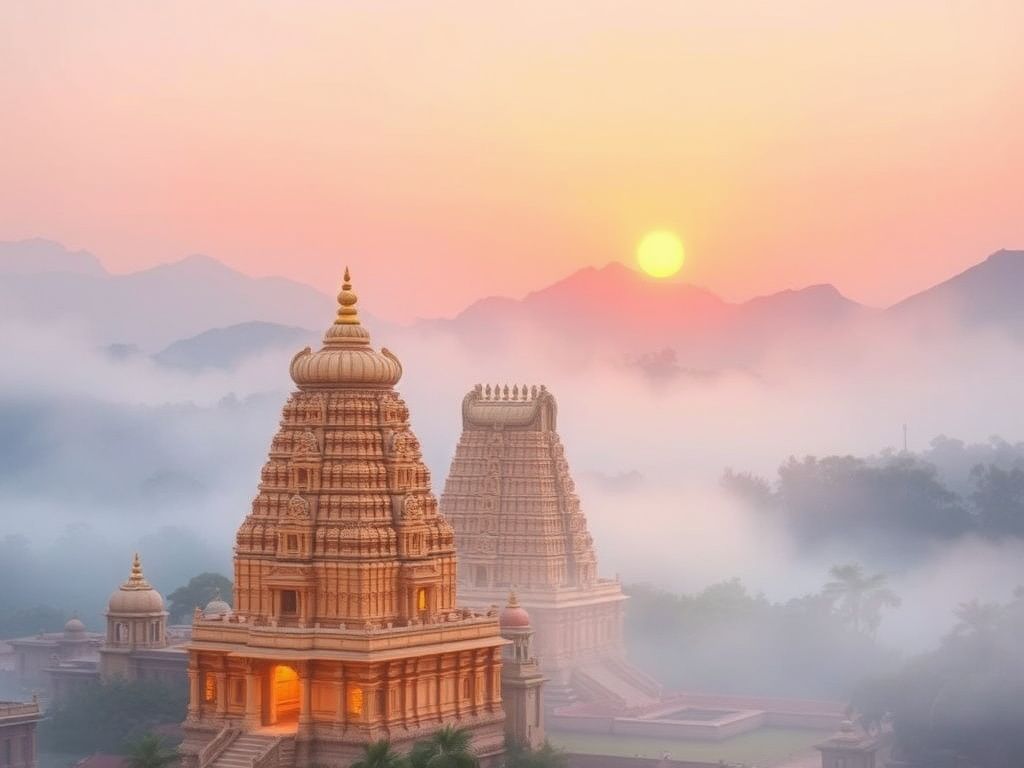
The Sthala Puranam of Tirumala is the sacred local history that explains why Lord Vishnu, as Sri Venkateswara, descended to the Seven Hills and chose this place as His abode for the Kali Yuga. It is the narrative behind every Tirumala pilgrimage, drawn from the Padma, Skanda, and Varaha Puranas. It accounts for the temple’s origin, the bond between Padmavathi and the Lord, the loan taken from Kubera, and the reason pilgrims still repay that debt at the Hundi today. Here is the full traditional account.
Table of Contents
Why Vishnu descended
As the Sthala Purana tells it, the Kali Yuga had begun and people had drifted from spiritual practice. While a hundred-year yajna was under way on the banks of the Ganga, the sages asked which of the Trimurti, Brahma, Vishnu or Shiva, deserved the fruit of the sacrifice. They chose Sage Bhrigu to test the three.
Bhrigu found Brahma and Shiva occupied, then came to Vishnu resting on Sesha. Without invitation he kicked the Lord in the chest. Where most beings would have reacted in anger, Vishnu answered with calm concern and asked whether Bhrigu’s foot had been hurt. The sages declared the offering belonged to Vishnu. But the act had a consequence: Goddess Lakshmi, who resides in Vishnu’s chest as Sridevi, was offended that her dwelling had been struck, and she left Him and descended to Earth as Bhargavi at Kolhapur.
Vishnu’s penance at Tirumala
Bereft of Lakshmi, Vishnu searched the world and, unable to find her, came to the Seven Hills of the south and entered a snake-ant hill on Venkatadri, where He performed long penance. A local shepherd grazed cattle there, and each day milk from one cow drained mysteriously into the ant hill. When the shepherd discovered the Lord inside and raised his axe in anger, the Lord emerged to shield the cow and the blow grazed His head, leaving a small bald spot.
Neela Devi, a Gandharva princess, saw the wound and offered her own hair to cover it. The Lord blessed her, declaring that hair offered by devotees at Tirumala would be accepted as her sacrifice. This is the divine origin of the Kalyanakatta tonsure tradition.
King Akasa Raja and Princess Padmavathi
While Vishnu lived at Tirumala in human form as Srinivasa, King Akasa Raja ruled the nearby Tondamandalam region. The king performed a yajna, a lotus rose from the earth bearing a baby girl, and he named her Padmavathi, born of the lotus.
Vakula Matha, held in tradition to be Yashoda reborn in the Kali Yuga, was caring for Srinivasa. A hunt for a wild elephant led Srinivasa to Padmavathi in her garden, and He was instantly enchanted. Recognising her son’s destiny, Vakula Matha went to Akasa Raja’s court to propose the marriage.
The loan from Kubera
Akasa Raja agreed, but Srinivasa had no wealth for a wedding fit for a princess. He approached Kubera, the divine treasurer, and borrowed an enormous sum of gold (one crore four lakh coins, by the traditional reckoning) to fund the celebration. Srinivasa promised to repay it over many ages, through the offerings of His devotees. This is why pilgrims give generously at the temple Hundi to this day: they are helping repay the Lord’s wedding debt, the interest on which, devotees believe, can be cleared only across the whole Kali Yuga.
The wedding and after
The wedding of Srinivasa and Padmavathi took place at Narayanavanam, a short distance from Tirumala, attended by gods and sages. The couple lived at Srinivasa Mangapuram, about 12 km from Tirupati, for six months before Srinivasa ascended to Tirumala to remain in His sanctum form as Sri Venkateswara. Goddess Padmavathi has her own temple at Tiruchanur, and pilgrims traditionally visit her first, honouring her as the Lord’s consort, before going up the hill.
Why it matters for pilgrims today
Knowing the Sthala Puranam changes how the pilgrimage feels on the ground:
- The hair offering connects you to Neela Devi’s first sacrifice.
- The Hundi donation takes part in repaying Kubera’s loan.
- Visiting Padmavathi at Tiruchanur first honours the divine wife who chose Vishnu.
- The daily Kalyanotsavam seva re-enacts the celestial wedding.
- The trip to Srinivasa Mangapuram traces the Lord’s post-wedding stay.
If you read only one part of this before your trip, make it the Kubera loan. For what it’s worth, it is the single piece that turns the long Hundi queue from a formality into something that actually means something while you are standing in it.
Common questions
Where can I read the Sthala Puranam in full? The Padma, Skanda, and Varaha Puranas carry the core narrative, and TTD has published authoritative Telugu and English editions.
Why does the Lord’s chest bear a mark? The vertical Srivatsa mark on the chest commemorates the incident with Sage Bhrigu and Lakshmi’s departure and return.
Are these events historical or symbolic? One honest point here: the Sthala Puranam is traditional sacred history, and the Puranas differ on small details such as names and sequence. Treat this as the mainstream TTD-published account rather than the only version. Within the tradition it is accepted as divine narrative; modern scholars read it as theological allegory.
What is Bhu Devi’s role? Bhu Devi, the goddess of the Earth, is the Lord’s other consort, represented on His other side in the sanctum and acknowledged across the temple sevas.
How does this relate to the Ramayana or Mahabharata? It is a separate sacred narrative specific to Tirumala, set in the Kali Yuga after the great epics, complementing rather than contradicting them.
Related reading
- Who was Vakula Matha, and her significance
- Sri Padmavathi Ammavari temple: timings and poojas
- Sri Kalyana Venkateswara temple at Srinivasa Mangapuram
- Tirumala Kalyanotsavam seva: booking and cost
For the official Sthala Puranam and detailed traditional accounts, see tirumala.org and the TTD portal at ttdevasthanams.ap.gov.in.