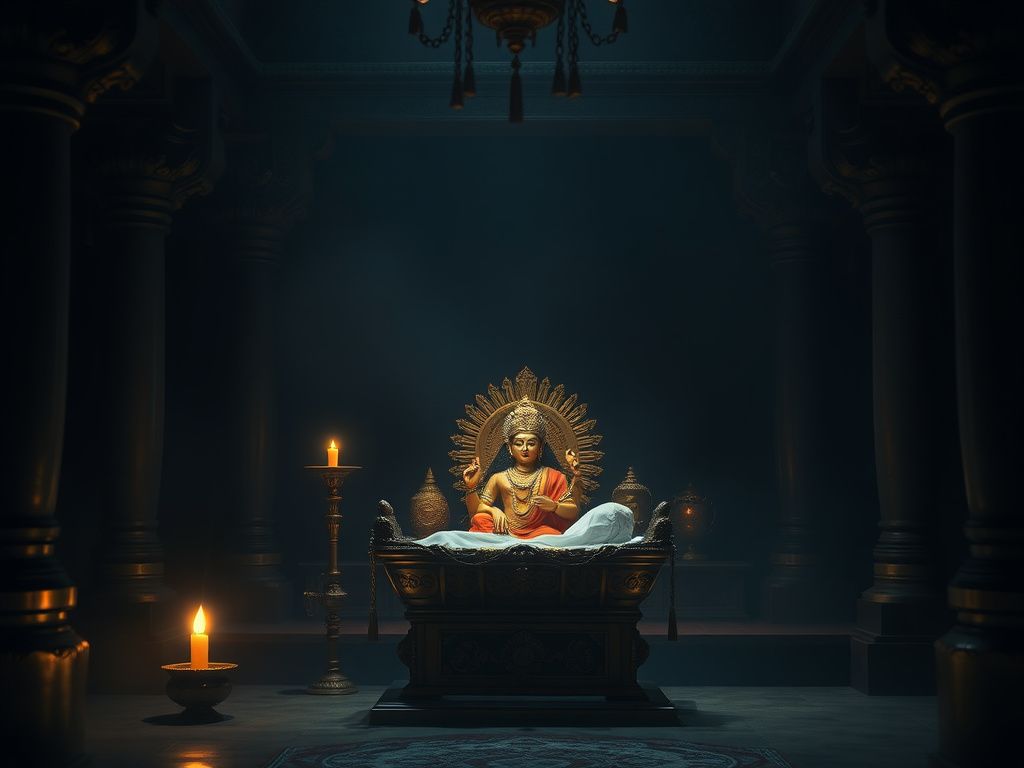
Just as the Tirumala day begins with the Suprabhata Seva, the gentle ritual awakening of Lord Venkateswara at dawn, it ends with the Ekanta Seva, the ceremony that puts the Lord to rest at night. This final service of the day is intimate in character: the Lord is offered a place of repose, a lullaby is sung, and the world is asked to withdraw. Understanding Ekanta Seva is to understand how the bhakti tradition at Tirumala treats the deity not as a stone image but as a living, beloved presence whose needs match those of any cherished being.
Table of Contents
What Ekanta Seva is
Ekanta is Sanskrit for solitude or privacy, and seva means service. Together the name describes exactly what happens: the Lord is given private rest, away from the crowds and rituals that fill the temple from before dawn. It is the last seva of the day, performed late at night after all other rituals and public darshan have concluded.
During the ceremony, a small utsava deity, often Bhoga Srinivasa or the Lord in a resting form, is placed in a golden cradle or ceremonial bed. The surroundings are quiet, the attendance limited, and the rites are performed with the tenderness appropriate to putting a beloved person to sleep.
The lullaby tradition
One of the most distinctive features of Ekanta Seva is the singing of a lullaby to the Lord. The lullaby (lali in Telugu) is not a modern addition; it is rooted in a very old tradition of expressing devotion through the imagery of parenting the divine. The Lord, treated as a beloved child being sung to sleep, receives the full tenderness of that relationship.
Verses from the Tarigonda Vengamamba tradition and other devotional compositions are sung on ordinary days. During the month of Dhanurmasam (the Tamil month of Margashira, roughly December to January), compositions of Annamacharya and others feature prominently in the night rituals. Annamacharya, the great 15th-century Vaishnava poet-saint whose compositions are inseparable from Tirumala’s devotional life, wrote in the vatsalya bhava (the parental mode of devotion), and his lullabies are among the most moving expressions of that tradition.
The daily ritual cycle
Ekanta Seva completes a full circuit of daily service to the Lord, a cycle that has been maintained without interruption for centuries:
- Suprabhata Seva: the Lord is awakened with hymns before dawn
- Tomala Seva: the Lord is adorned with flowers
- Archana, Naivedyam, and the day’s arjitha and nitya sevas
- Public darshan throughout the day and evening
- Ekanta Seva: the Lord is put to rest late at night
The unbroken nature of this cycle, no day skipped and no seva omitted, is itself a form of devotion. The priests and archakas who maintain it regard the continuity as sacred.
The theology of Ekanta Seva
The bhakti tradition speaks of different modes (bhavas) through which a devotee can relate to the divine: as a servant to a master (dasya), as a friend (sakhya), as a parent (vatsalya), as a lover (madhura). Ekanta Seva operates primarily in vatsalya bhava, the parental mode, in which the devotee’s love for the Lord is expressed through care, protection, and tenderness.
Singing a child to sleep is an act of complete, selfless attention. It asks nothing in return. It is simply presence and care. When this act is directed toward the Lord, it becomes what the tradition calls a high form of devotion, because the ego of the worshipper is fully absorbed in the act of service.
Pilgrims who have attended Ekanta Seva consistently describe it as one of the most affecting experiences at Tirumala, perhaps because the intimacy of the setting and the lullaby bring the devotional relationship into a very human register.
Participation and booking
Ekanta Seva is an arjitha seva, meaning it is a paid, advance-booked service with limited participation. The booking portal is ttdevasthanams.ap.gov.in, where the monthly arjitha seva quota is released by TTD. Given the late-night timing, participants should plan their accommodation at Tirumala in advance; TTD guesthouses can be booked through the same portal.
The way I see it, attending Ekanta Seva and then Suprabhata Seva on consecutive mornings gives a pilgrim the full arc of the Lord’s day, from waking to sleeping, and that complete experience is worth arranging a two-night stay for.
To set expectations: the exact time of Ekanta Seva varies and can shift based on the day’s ritual schedule; it is performed after all other sevas are complete, which means the start time is not fixed in the way a clockwork appointment would be. Confirm the current timing details on tirumala.org or ttdevasthanams.ap.gov.in before booking.
Common questions
What is Ekanta Seva? The final ritual of the day at Tirumala, in which the Lord is ceremonially put to rest at night, completed with a traditional lullaby.
Is a lullaby actually sung? Yes. A traditional lali (lullaby) is sung to the Lord; during the month of Dhanurmasam, special compositions are featured in the night rituals.
Which deity is put to rest? A small utsava deity, often Bhoga Srinivasa, is placed in a golden cradle or ceremonial bed for the night.
Can devotees attend? Ekanta Seva is an arjitha seva with limited participation. Check current availability and booking details on ttdevasthanams.ap.gov.in.
What does vatsalya bhava mean? Vatsalya bhava is the parental mode of devotion, expressing love for the Lord as a parent’s love for a child. It is the bhava that Ekanta Seva most fully embodies.
How does Ekanta Seva relate to Suprabhata Seva? They are the two ends of the same daily cycle. Suprabhata Seva awakens the Lord before dawn, and Ekanta Seva puts Him to rest late at night. Together they frame the entire day of service.
Does Ekanta Seva happen every day? Yes. It is a daily nitya (regular) seva, performed without interruption as part of the Lord’s daily ritual cycle.
Related reading
- Ekantha Seva at Tirumala — Details and Booking
- Suprabhata Seva — The Sacred Awakening
- Complete List of Tirumala Daily Sevas