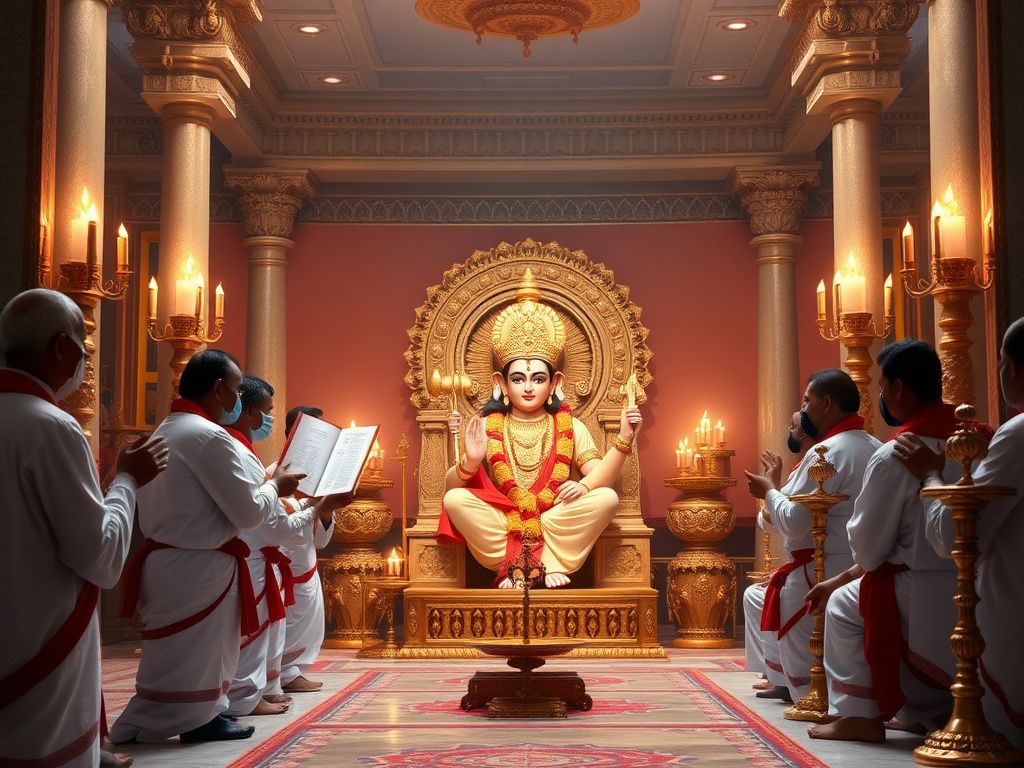
Among the dozens of daily rituals at Tirumala, the Koluvu stands out for what it says about how the tradition understands the Lord. Also called Durbar, it is the morning court ceremony in which Lord Venkateswara is treated not merely as a deity receiving worship but as the living sovereign holding His daily royal audience. During Koluvu, the day’s panchangam (the Hindu almanac recording tithi, nakshatra, yoga, and karana) is formally read before the Lord, and a symbolic account of the temple’s affairs is presented, exactly as a king’s court would begin its day. The ritual is a daily enactment of the concept of the Lord as universal monarch.
Table of Contents
What Koluvu is
Koluvu is a Telugu word meaning court or royal assembly. It is the morning ceremony in which the utsava deity, the processional form traditionally referred to as Koluvu Srinivasa, is seated in a setting that mirrors a royal durbar. The proceedings follow a formal pattern:
- The day’s panchangam is read aloud before the Lord, covering the tithi (lunar day), nakshatra (star), yoga, and karana for the day
- The previous day’s hundi (donation box) accounts are symbolically presented
- The Lord, treated as the reigning king, is informed of the day’s affairs and the cosmic time in which that day unfolds
- The ritual establishes an auspicious tone for the temple’s entire day of service
The parallel to a royal court is not incidental. The Agama Shastra tradition that governs temple practice at Tirumala prescribes treating the Lord through every phase of a dignified human day: awakening, bathing, adornment, feeding, receiving audiences, resting, and finally being put to bed. Koluvu is the court-audience phase of that daily cycle.
Place in the daily ritual cycle
The temple day at Tirumala runs through a long sequence of sevas from before dawn until late at night. Koluvu follows the morning awakening (Suprabhatam, the famous devotional hymn sung at dawn) and the floral adornment seva (Tomala Seva). It precedes the opening of darshan to the public. The sequence looks roughly like this:
- Thiruvanandal (pre-dawn rituals)
- Suprabhatam (awakening hymn)
- Tomala Seva (garland adornment)
- Koluvu (morning court)
- Archana and other morning sevas
- Public darshan opens
Understanding this sequence helps pilgrims appreciate that by the time they join the darshan queue, the Lord has already been awakened, adorned, and has held His morning court. The darshan they receive is set within a day the temple has already formally begun in a precise ritual order.
The significance
- The Lord as sovereign: Koluvu affirms that Venkateswara is not a passive icon but the active ruler of the universe, holding real court each morning
- Alignment with cosmic time: Reading the panchangam connects the Lord’s day to the exact positions of celestial bodies, grounding temple life in the astronomical framework that underpins the Hindu calendar
- Accountability before the divine: The symbolic presentation of the hundi accounts reflects a centuries-old tradition of conducting the Lord’s affairs with transparency and fidelity, as any steward would report to a king
- Continuity: The ritual is maintained every single day of the year without exception, linking each day to the same unbroken tradition stretching back through the centuries of the temple’s documented history
Who can attend
Koluvu is a restricted seva and not open to general pilgrims in the way that darshan or street processions are. Only those with specific seva bookings or temple passes for that ritual are admitted to the inner precincts where it is conducted. General visitors who want to understand the daily ritual cycle should look for information about it on tirumala.org, where TTD publishes details of sevas and the daily schedule.
The detail I’d flag is that the experience of knowing Koluvu has happened before your darshan adds meaning to the visit even if you never attend the ritual directly: the Lord you see has already been informed of the day, already been presented the almanac, already held court. You are arriving mid-way through a day the tradition has carefully structured from before sunrise.
One practical limitation: precise information about which sevas are open to visitors and under what conditions can change. Always verify on news.tirumala.org or ttdevasthanams.ap.gov.in before assuming any seva can be attended or booked.
Common questions
What does Koluvu mean? Court or royal assembly in Telugu. At Tirumala it refers to the Lord’s daily morning durbar ceremony.
What happens during Koluvu? The day’s panchangam is read aloud before the utsava deity, and the previous day’s temple accounts are symbolically presented, mirroring the proceedings of a royal court.
When is it performed? In the morning sequence, after Suprabhatam and Tomala Seva, and before darshan opens to the public.
Why is the almanac read before the Lord? Reading the panchangam aligns the Lord’s day with the precise cosmic time, placing the temple’s rituals within the same astronomical framework that governs the Hindu calendar.
Which deity presides at Koluvu? The utsava (processional) form, traditionally referred to as Koluvu Srinivasa.
Can pilgrims attend Koluvu? It is a restricted seva, not part of general darshan. Check TTD’s official channels for current information on access.
How does Koluvu fit into the full day? It is one stage in a continuous daily cycle that runs from pre-dawn awakening rituals through late-night bedding, treating the Lord’s day as that of a living sovereign from start to finish.
Related reading
- Koluvu or Durbar at Tirumala: Details and Importance
- Suprabhata Seva — The Sacred Awakening
- Ekanta Seva — The Night Rest Ritual
- Complete List of Tirumala Daily Sevas