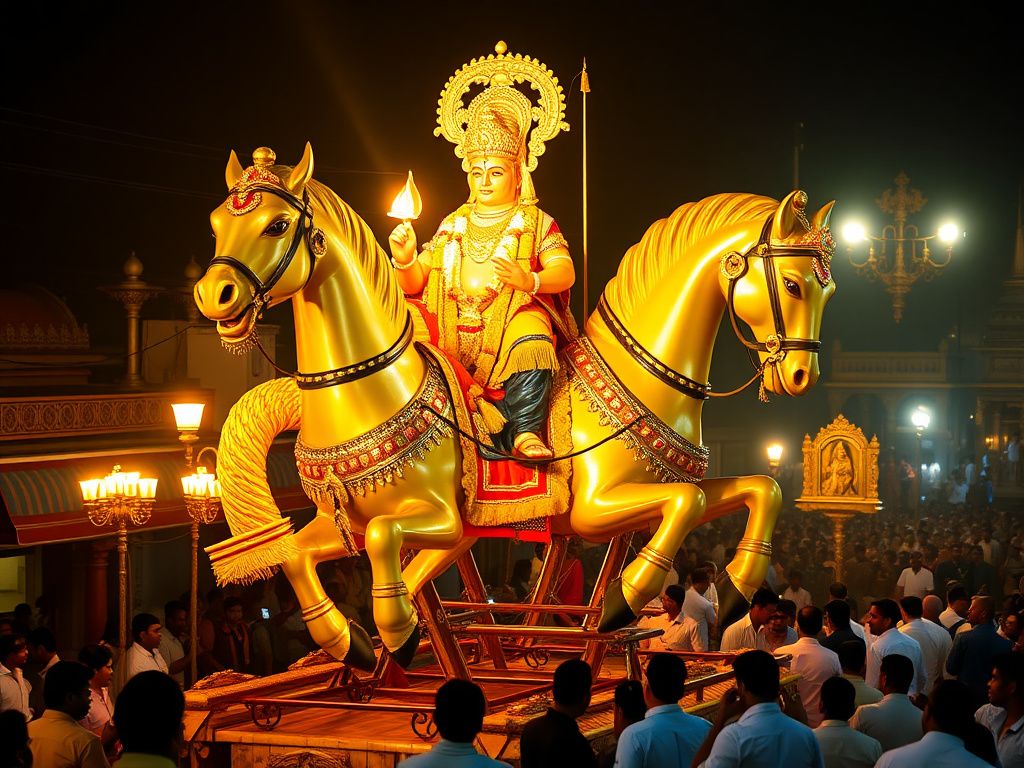
On the seventh day of the Tirumala Brahmotsavam, Lord Malayappa Swamy is taken in procession on the Aswa Vahanam, a golden horse vehicle. Among the sixteen vahana sevas of the festival, the horse carries a distinctive forward-looking symbolism: it evokes Kalki, the future and final avatar of Lord Vishnu, who is prophesied to appear on a white horse at the end of the Kali Yuga to restore dharma to the world.
Table of Contents
The symbolism of the horse vahanam
The horse in Indian tradition is not simply a vehicle; it carries a specific set of associations. Speed, power, and purposeful forward movement are the horse’s primary qualities. In the Vedic context, the horse is associated with sovereignty and cosmic energy. In the Puranic context, it is the Kalki connection that dominates:
- Kalki connection: The Kalki avatar is described in the Puranas as appearing on a white horse, wielding a blazing sword, at the end of the Kali Yuga to end an age of corruption and restore righteousness. The Aswa Vahanam evokes this prophesied descent.
- Speed and energy: The horse represents swiftness and dynamic divine action, the Lord’s capacity to act decisively when dharma requires it.
- Victory over adharma: Kalki’s mission is to bring the age of darkness to a close and begin a new cycle. The vahanam carries this promise of renewal.
- Hope for devotees: The procession reminds pilgrims that the Lord’s intervention is not only a matter of the past (through previous avatars) but also a continuing promise for the future.
Kalki: the tenth avatar
The Dashavatara, the ten principal avatars of Lord Vishnu, includes nine that have already descended: Matsya (fish), Kurma (tortoise), Varaha (boar), Narasimha (man-lion), Vamana (dwarf), Parashurama, Rama, Krishna, and the Buddha or Balarama depending on the tradition. Kalki is the tenth, still to come. The Puranic descriptions of Kalki emphasise that he will appear when the world has reached a state of extreme moral degradation, and his arrival will both end the Kali Yuga and initiate the next Satya Yuga.
The Aswa Vahanam at Brahmotsavam places this eschatological promise at the centre of the festival’s celebration. By mounting the horse, Lord Venkateswara — already understood as Vishnu Himself — affirms His identity as the one who has come before and will come again.
Place in the Brahmotsavam sequence
The Aswa Vahanam on Day 7 follows the great Garuda Vahanam (Day 5) and the Hanumantha Vahanam along with the Swarna Ratham (Day 6). It carries the festival into its concluding days, building toward the Rathotsavam (chariot procession) and the Chakra Snanam on the final day, when the bathing of the Sudarshana Chakra formally closes the Brahmotsavam.
The 2026 Brahmotsavam is scheduled for 15-23 September 2026 (Salakatla) and 12-20 October 2026 (Navaratri, Adhika Masa). Within each nine-day festival, the Aswa Vahanam falls on Day 7. For confirmed timings, refer to news.tirumala.org as the festival approaches.
The experience of Day 7
In practice, the Aswa Vahanam is one of the later-evening processions of Brahmotsavam, and the crowds by Day 7 of the festival have usually settled into a rhythm. Regular Brahmotsavam attendees often say that the later vahana sevas, past the peak excitement of the Garuda Vahanam, feel more contemplative, a different quality of experience from the earlier peak days.
How to witness the procession
The Aswa Vahanam procession is held in the public mada streets surrounding the Tirumala temple and is free for all devotees; no ticket or advance booking is required for standing along the route. For premium arati viewing during certain sevas, check ttdsevaonline.com for Arjitha Seva booking options, which vary each year.
- Arrive early to secure a viewing position along the mada streets.
- The procession includes Vedic chanting, nadaswaram, and devotional music throughout its circuit.
- The golden horse vehicle is elaborately decorated, and the deity is richly adorned for the procession.
To set expectations, even on Day 7 the festival draws very large crowds, and the mada streets can be packed for hours before and during the procession. Those with physical mobility concerns or young children should factor this in when planning.
Common questions
What does the horse symbolise in the Aswa Vahanam? It evokes the Kalki avatar, swiftness, power, and the ultimate victory of dharma at the end of the Kali Yuga.
Which day of Brahmotsavam is the Aswa Vahanam? The seventh day.
Who is Kalki? The prophesied tenth and final avatar of Vishnu, described in the Puranas as appearing on a white horse to bring the Kali Yuga to a close and restore righteousness.
Do I need a ticket to watch the procession? No. Vahana processions in the mada streets are free for all devotees.
When is the 2026 Brahmotsavam? 15-23 September 2026 (Salakatla) and 12-20 October 2026 (Navaratri, Adhika Masa).
What happens after the Aswa Vahanam in the festival sequence? The festival continues toward the Rathotsavam (chariot procession) and concludes with the Chakra Snanam on the final day.
How do I find confirmed timings for the Aswa Vahanam? Refer to news.tirumala.org as the festival date approaches; day-by-day vahana timings are typically published close to the start of each Brahmotsavam.