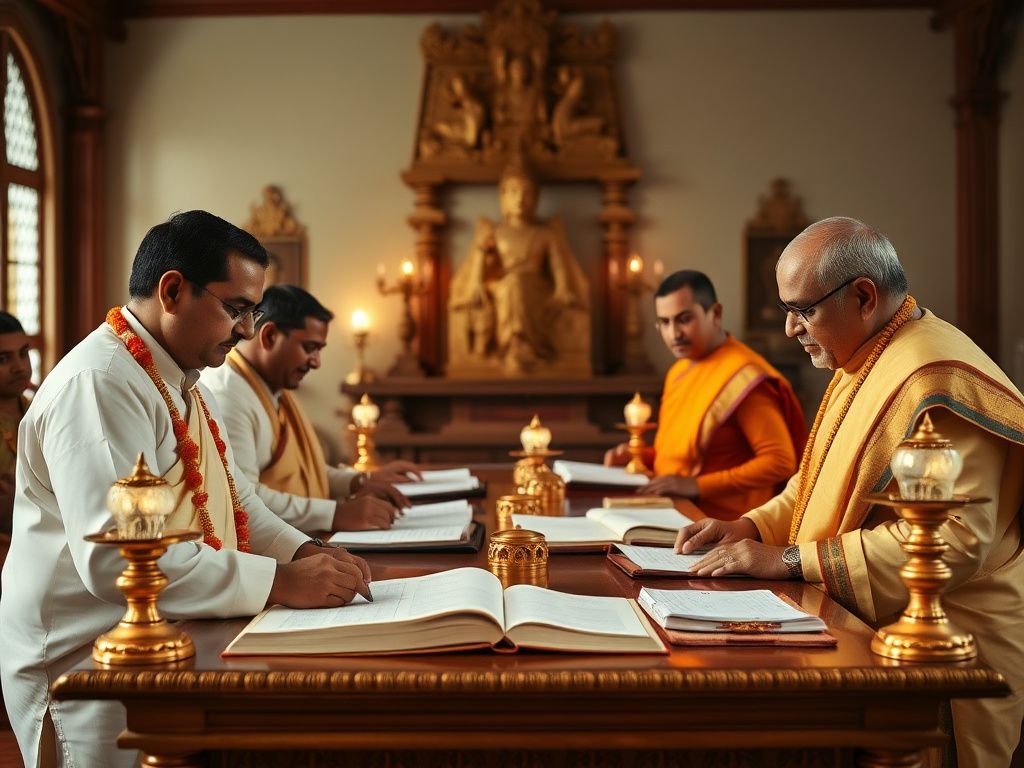
Anivara Asthanam is the annual court ritual at Tirumala that formally closes the temple’s ritual fiscal year. Held on a date in the Hindu lunar calendar that typically falls in late March or early April, near Ugadi but governed by the temple’s own reckoning rather than the civil Telugu New Year, it brings together chief priests, accountants, and trustees in a ceremony that has been observed for centuries. The year’s hundi collections are reported, major donors are named aloud, and the ledger is formally shut before the new ritual cycle opens the following day. For pilgrims who happen to be on the Hill that morning, it is one of the quieter yet most historically layered occasions in the entire Tirumala calendar.
Honestly, this is one of the rituals that reveals how Tirumala operates simultaneously as a living royal court and a modern institution, the same ledger-closing logic that any accountant would recognise, performed in the idiom of a divine king’s audience chamber.
Table of Contents
What the name means
Both words in the name carry precise meaning:
- Anivara (Telugu) means year-end or completion, the concluding moment of a cycle.
- Asthanam means court or formal session, drawn from the classical concept of a royal assembly.
Together they describe a year-end court session. The phrase is not liturgical poetry; it is an administrative title that accurately names what the event does: it convenes the temple’s formal court to conclude the year’s accounts.
The royal-court tradition behind Asthanams
Tirumala treats Sri Venkateswara as a reigning sovereign, and the Asthanam tradition reflects that directly. Classical South Indian temple administration inherited the protocol of royal audiences, in which the deity holds court at set intervals just as a human king would. Three tiers of Asthanam are observed at Tirumala:
- Daily Koluvu, the morning court held each day, in which the previous day’s offerings and collections are reported to the deity.
- Festival Asthanams, special court sessions on auspicious occasions such as Ugadi, Vaikuntha Ekadasi, and major Brahmotsavam days.
- Anivara Asthanam, the annual closing court that concludes the full ritual-fiscal year.
Each Asthanam reaffirms the deity’s royal-divine status and the temple’s role as his court. Anivara Asthanam is, in this hierarchy, the most comprehensive: it covers an entire year’s activity rather than a single day or festival period.
What happens during the ceremony
The sequence of the Anivara Asthanam follows an established order:
- Sri Malayappa Swamy, the processional form of the deity, is brought to the formal Asthanam setup in the temple precincts.
- Chief priests, accountants, and trustees assemble before him as attendants in a royal court.
- The year’s hundi collections are formally reported in the deity’s presence.
- The names of major donors of the year are read aloud, honouring their contribution.
- Asthanam Asirvachanam, a formal blessing, is pronounced for the temple’s ongoing welfare.
- Special daksha puja offerings are presented to conclude the ceremony.
- The day’s accounts are formally closed in the ledger.
- The next year’s first entry is opened, marking the start of the new ritual cycle.
The structure mirrors a royal year-end audit conducted in the presence of the sovereign, which is precisely what Tirumala’s theological framework understands it to be.
Why the temple maintains a ritual fiscal year
Tirumala has functioned as a major economic and ritual institution for centuries. The annual cycle serves multiple practical and spiritual purposes:
- Donor records are totaled and acknowledged, honouring every significant contribution.
- Annual privileges due to donors are calculated for the coming year.
- The next year’s ritual calendar is formally instated under the deity’s authority.
- Any pending obligations from the past year are settled before the new cycle opens.
- The temple’s spiritual “balance sheet” is reviewed publicly, maintaining transparency in the tradition of royal accounting.
This is the ritual equivalent of a modern annual closing, conducted in the traditional Asthanam format rather than a boardroom. The continuity between ancient court practice and contemporary temple governance is one of the reasons TTD’s administrative model draws scholarly attention.
When Anivara Asthanam falls and how to confirm dates
The date is set by the Hindu lunar calendar and typically falls in late March or early April, aligned with the close of the temple’s own ritual year rather than the Gregorian financial year. It lands near Ugadi, the Telugu New Year, but the two are distinct: Ugadi is the civil calendar new year, while Anivara Asthanam is governed by the temple’s internal reckoning of its ritual-fiscal cycle.
Because the lunar date shifts each year, the precise Gregorian date changes annually. The only reliable source for the current year’s Anivara Asthanam date is the official TTD news portal at news.tirumala.org, which publishes the festival and special-seva calendar ahead of each season. One practical limitation of planning around Anivara Asthanam is that TTD announces dates relatively close to the event; building in flexibility for your travel dates is advisable rather than booking fixed transport far in advance.
How pilgrims can participate
There are three main ways to engage with Anivara Asthanam, depending on your connection to the temple:
- Witness as a spectator. Free attendance at the temple courtyard during the Asthanam is open to all pilgrims. No prior booking is required for this.
- Sponsor through Asthanam Seva. Limited Arjitha Seva slots are available for devotees who wish to be formally named during the ceremony’s reading. These slots must be booked in advance through ttdsevaonline.com.
- Donor acknowledgment. Major donors of the year have their names read out automatically as part of the formal proceedings, without any separate booking needed.
For most pilgrims, Anivara Asthanam represents a particularly auspicious darshan occasion rather than a seva they actively book. Crowds on this day tend to be smaller than during the well-known festivals such as Brahmotsavam or Vaikuntha Ekadasi, which can make it a practical time to visit for those who find the Hill overwhelming during peak gatherings.
Planning a visit around Anivara Asthanam
Pilgrims who want to time their visit to coincide with the ceremony should consider a three-day window:
- Day before Anivara Asthanam: Complete regular darshan and confirm accommodation. Rooms at TTD guest houses can be reserved through ttdsevaonline.com; trains to Tirupati can be booked via irctc.co.in.
- Anivara Asthanam day: Attend the special Asthanam viewing in the morning, then proceed to regular darshan.
- Day after: The temple enters its new ritual year. Consider booking Kalyanotsavam or other auspicious-day sevas to begin the new cycle.
Common questions
Is Anivara Asthanam widely known among pilgrims? Less so than Brahmotsavam or Vaikuntha Ekadasi. Devoted Vaishnavas and those familiar with temple administration tend to know it; general pilgrims may discover it only on arrival or through TTD’s news announcements.
Can I attend without booking any seva? Yes, free public attendance at the temple courtyard during the Asthanam ritual is open to all. No booking is required to witness the ceremony.
How does Anivara Asthanam differ from Ugadi? Ugadi is the Telugu New Year on the civil lunar calendar. Anivara Asthanam is the temple’s own ritual-fiscal year end. They fall close to each other in date but govern entirely different cycles and carry distinct ceremonial meanings.
Who reads out the donor names? The chief priests conduct the formal reading as part of the Asthanam proceedings, in the presence of Sri Malayappa Swamy and the assembled trustees.
Is this the only Asthanam of the year? No. Tirumala observes Asthanams at multiple points in the calendar, the daily Koluvu each morning and festival Asthanams on significant occasions. Anivara Asthanam is the annual closing court, the most comprehensive of them all.
Where can I confirm the current year’s date? The authoritative source is news.tirumala.org, which publishes TTD’s official calendar and event announcements.
Related reading
- Salakatla Brahmotsavam, dates, schedule, and significance
- Dwajarohanam, Flag Hoisting at Tirumala
- Chinna Sesha Vahanam
- Kalpavruksha Vahanam
- Sarva Bhoopala Vahanam