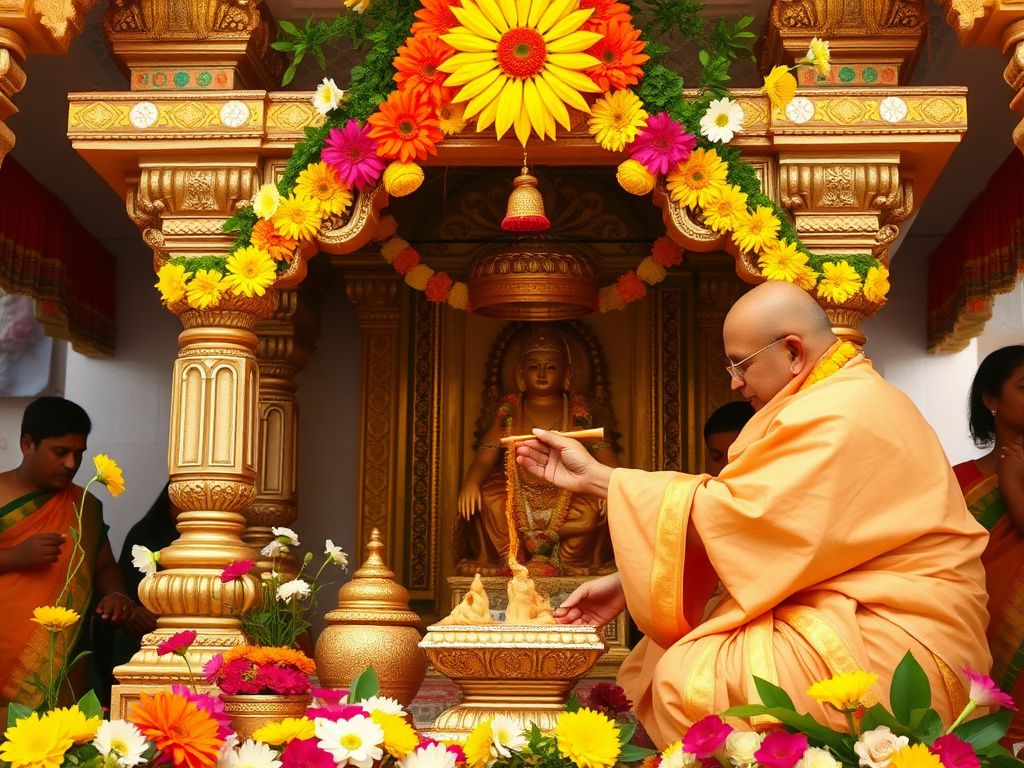
Arjitha Vasanthotsavam is one of the most visually stirring Arjitha Sevas at Tirumala, celebrated each year during the Vasanta (spring) season, roughly corresponding to the Chaitra-Vaisakha months of March and April. Unlike many daily sevas, this is a three-day continuous ritual that marks the changing of the season with floral abundance, sandalwood fragrance, and the melodic keertanas of the saint-composer Annamacharya. For devotees who have attended, the sight of Sri Malayappa Swamy seated in the Vasanta Mandapam surrounded by spring flowers remains one of the most vivid memories of a Tirumala visit.
The ticket costs Rs. 200 per person per day, making it one of the more accessible Arjitha Sevas on the Tirumala calendar. Online quota is released on the first Friday of each month for the following month, through the standard TTD booking system.
Table of Contents
What happens during Vasanthotsavam
At the heart of the seva is the procession of Sri Malayappa Swamy, accompanied by Sridevi and Bhudevi, to the Vasanta Mandapam, a specially decorated festival hall within the temple complex. Once the utsava murthy (processional deity) is seated, the ritual follows a structured sequence:
- Three-day continuous ritual celebrating the Vasanta (spring) season
- Sri Malayappa Swamy with Sridevi and Bhudevi placed in the Vasanta Mandapam
- Sandalwood paste application (Chandanabhishekam) on the deity
- Flower shower (Pushparchana) offered by devotees
- Annamacharya keertanas specific to the spring season, sung by temple musicians
- Special Vasanta-themed prasadam distribution
The Chandanabhishekam, in which the deity is anointed with sandalwood paste, is a cooling rite associated with both devotion and auspiciousness. The Pushparchana that follows, where flowers are showered on the deity, transforms the mandapam into a fragrant spectacle that pilgrims describe as unlike any other moment in the temple calendar.
The significance of Vasanta in this ritual
In Hindu tradition, Vasanta is far more than a meteorological season. It is counted among the six ritutu (seasons) specifically mentioned in Vedic literature, and it carries connotations of renewal, fertility, and the grace of Vishnu. The Bhagavata Purana describes the Lord as being especially manifest in the beauty of spring. The Vasanthotsavam at Tirumala draws on this ancient association, framing the three-day celebration as a cosmic acknowledgment of the season’s arrival.
The seva also connects, thematically, to the wedding of Lord Venkateswara and Padmavathi, which is re-enacted daily through the Kalyanotsavam. Spring is traditionally considered auspicious for divine unions, and the Vasanthotsavam can be understood as celebrating the Lord in the fullness of that seasonal grace. For pilgrims who attend, this layered meaning adds depth beyond the visual spectacle.
If you ask me, attending all three days of the Vasanthotsavam, rather than just one, gives a significantly richer understanding of how the ritual builds from its opening to its conclusion, but even a single day is spiritually complete on its own.
How Vasanthotsavam differs from other sevas
Devotees sometimes confuse Vasanthotsavam with Sahasra Kalashabhishekam. The two are distinct in both structure and timing. Sahasra Kalashabhishekam is a weekly Wednesday-only seva in which 1,008 silver pots are used in an abhishekam ceremony, whereas Vasanthotsavam is a seasonal, three-day spring celebration built around chandana abhishekam (sandalwood paste) and flower offerings. The two involve different deities, different mandapams, and different ritual purposes. Pilgrims looking to plan around specific sevas should check the ttdevasthanams.ap.gov.in calendar to confirm which seva falls on which date.
Booking Vasanthotsavam
The ticket for Arjitha Vasanthotsavam costs Rs. 200 per person. Each day of the three-day cycle requires a separate Rs. 200 ticket, so attending all three days costs Rs. 600 per person in total. Some devotees prefer to attend all three for the full festival experience.
Online quota is released on the first Friday of each month, covering sevas for the following month. A lucky-dip system applies for premium dates, particularly the last 2-3 days of the three-day cycle, which tend to be the most sought-after. Booking is done through ttdevasthanams.ap.gov.in under Arjitha Sevas, then Vasanthotsavam. Confirmed quota release dates and any changes to the schedule are also published at news.tirumala.org.
One thing to keep in mind: because this is a seasonal seva tied to the Vasanta months, quota windows can fill rapidly when the festival coincides with school holidays or long weekends, so booking on the first Friday quota release day is advisable rather than waiting.
Reporting, dress, and what devotees receive
On the day of the seva, devotees should report at Supadam Q gate 1 hour before the scheduled seva time. TTD enforces a traditional dress code: men must wear dhoti and angavastram; women must wear a saree with blouse only. Other dress will not be admitted.
On completing the seva, each participant receives:
- Witness the seva from the Vasanta Mandapam
- Special Entry Darshan after the seva concludes
- Two laddus and sandalwood prasadam
- A Vasanta-themed flower garland
Photography inside the mandapam is not permitted. Pilgrims are advised to leave cameras and large bags with the cloak room before reporting at the Q gate. Further travel logistics, including trains to Tirupati, can be planned via irctc.co.in, and APSRTC buses from major Andhra Pradesh cities can be booked at apsrtconline.in.
Common questions
Is Vasanthotsavam held year-round? No. It is a seasonal seva typically held during the Vasanta season, which corresponds to the Chaitra-Vaisakha months of March and April. Exact dates vary by year and should be confirmed through the official booking portal.
How much does Vasanthotsavam cost per person? The ticket costs Rs. 200 per person per day. Attending all three days of the festival requires three separate tickets, totalling Rs. 600 per person.
Can I book all three days at once? Yes, three separate Rs. 200 tickets can be booked. Some devotees attend all three for the full spring festival experience. The lucky-dip system applies for the last 2-3 days of the cycle.
When does online quota open? Online quota is released on the first Friday of each month for the following month. Premium dates within the three-day cycle can be competitive, so early booking on quota release day is recommended.
Where do I report on the day? Report at Supadam Q gate 1 hour before the seva time listed on your ticket. Late arrivals may forfeit their slot.
Is photography allowed inside the mandapam? No. Photography is not permitted inside the Vasanta Mandapam during the seva.
What prasadam do participants receive? Each participant receives two laddus, sandalwood prasadam, and a Vasanta-themed flower garland, along with Special Entry Darshan after the seva.
Related reading
- Kalyanotsavam Seva Booking
- Suprabhata Seva Booking
- Sahasra Deepalankarana Seva
- Ekantha Seva (Midnight)
- Unjala (Dolotsavam) Seva