
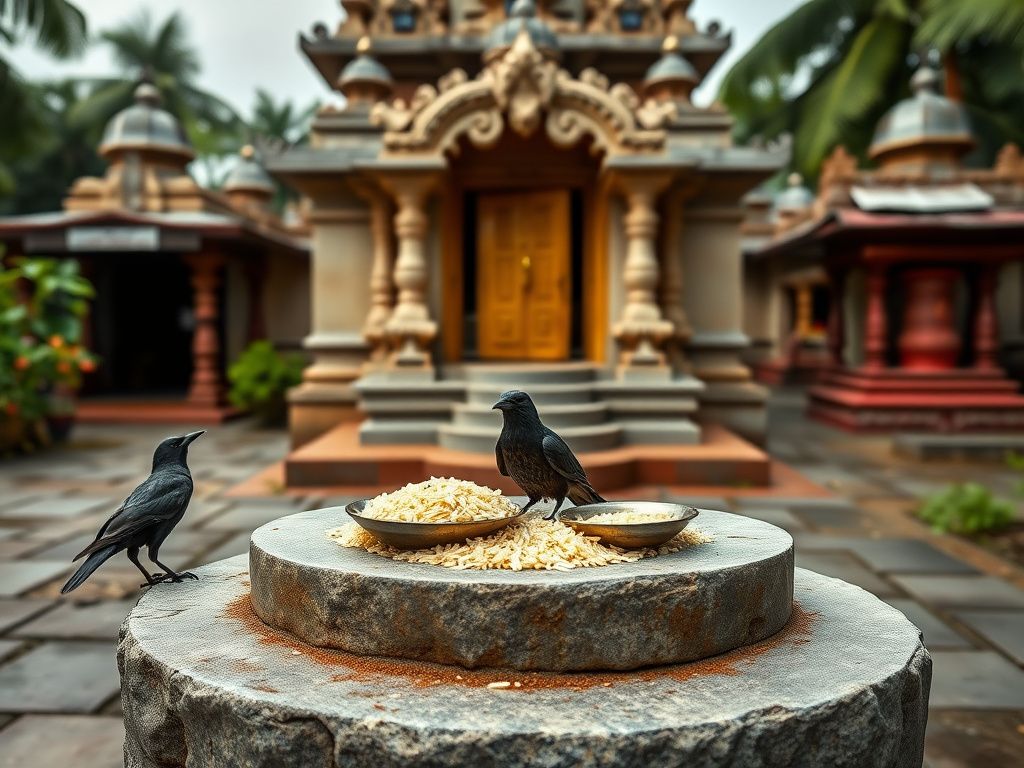
Every afternoon at Tirumala, a small but ancient act unfolds quietly outside the main temple compound: a portion of the day’s cooked rice and prasadam is set aside and placed at a designated spot for crows and other birds. This is Kaka Bali, a ritual observed daily as part of the temple’s continuous devotional cycle, and it carries far more theological weight than its modest appearance suggests.
Kaka Bali joins a living chain of religious obligation that ties Tirumala’s priests to the natural world, to the departed, and to the full sweep of Hindu cosmology. For pilgrims who notice it during their visit, understanding its meaning adds depth to the entire Tirumala experience.
Table of Contents
What the name means
The term breaks cleanly into two Sanskrit roots:
- Kaka, crow
- Bali, offering or act of giving (not violent sacrifice; the word conveys a gift made in devotion)
Together: “Offering to crows.” The name is direct, but the tradition it names reaches into one of Hinduism’s oldest understandings of duty toward ancestors.
The ancestor connection
In Hindu belief, crows occupy a specific and honoured role as messengers between the living world and Pitru-loka, the realm where ancestors reside after death. When the living offer food to crows, tradition holds that the food reaches the deceased symbolically. This is not merely folklore. It underpins the formal shraddha ceremonies that families perform for departed relatives and reaches its annual peak during Pitru Paksha, the fortnight in September to October dedicated entirely to ancestor rites.
Tirumala’s daily Kaka Bali does not replicate the personal, family-focused Pitru rituals performed at home. Instead, it expresses a broader principle: the temple, as an institution serving all of humanity, maintains an ongoing offering to all beings without distinction. The specific attachment to individual ancestors is absent; the universal obligation to feed and honour life remains.
Part of the Pancha Mahabali tradition
Kaka Bali sits within a larger Vaishnava framework known as Pancha Mahabali, the five great offerings. Each addresses a different sphere of existence:
- Deva Yajna, offering to the gods
- Pitru Yajna, offering to ancestors
- Manushya Yajna, offering to human beings, through hospitality and charity
- Bhuta Yajna, offering to all living creatures, which includes Kaka Bali to crows and birds
- Brahma Yajna, offering through the study and transmission of sacred knowledge
Tirumala’s ritual calendar addresses all five. Nivedana (food presented to the deity) fulfils Deva Yajna. Donor schemes and endowments cover Pitru Yajna. The free annaprasadam dining halls, which feed thousands of pilgrims daily, fulfil Manushya Yajna. Kaka Bali fulfils Bhuta Yajna. Veda parayanam, the continuous recitation of Vedic texts by temple priests, fulfils Brahma Yajna.
Kaka Bali is therefore not an isolated curiosity. It is the temple’s daily declaration that its duties extend beyond the deity’s sanctum to every creature in the world.
How Kaka Bali is performed
The sequence fits naturally into Tirumala’s afternoon ritual cycle:
- After Nivedana, a portion of the cooked rice and prasadam is set aside by temple staff
- The offering is carried to a designated spot outside the temple compound
- It is placed there for crows and other birds to consume
- The ritual falls between Madhyaahna Bhoga and the evening sevas, typically in the afternoon between 2:00 PM and 4:00 PM, though exact timing can vary seasonally
The rice used for Kaka Bali is a small portion drawn from the same day’s prasadam preparation. The remainder goes to the annaprasadam dining halls for pilgrims. Devotees who happen to be in the outer precincts during this time may witness the gathering of crows, though the ritual itself is conducted by temple staff rather than by visitors directly.
Honestly, watching crows converge on the offering spot, seemingly on schedule, gives even a sceptical visitor a quiet pause; there is something in that gathering that the temple tradition has clearly observed across many centuries.
The Goshala: Bhuta Yajna extended to cows
Tirumala also operates the Sri Venkateswara Goshala, a cow protection facility that applies the Bhuta Yajna principle on a larger, ongoing scale. Care of cows ranks among the most prominent expressions of animal welfare in Hindu practice, and the Goshala formalises that duty. Considered together, Kaka Bali for birds and the Goshala for cows represent the temple’s full expression of bhuta yajna: every creature, from the smallest bird at the offering spot to the cows in the care facility, falls within the circle of the temple’s daily obligation.
The Sri Venkateswara Gosamrakshana Trust provides a structured channel for devotees who wish to support cow protection work at Tirumala beyond a single visit.
How devotees can engage
One practical limitation: the formal Kaka Bali is a temple-conducted ritual, so pilgrims do not directly participate by feeding crows during the ceremony itself. That said, there are meaningful ways to engage:
- Position yourself in the outer precincts in the afternoon (roughly 2:00 PM to 4:00 PM) to observe the offering and the birds’ response
- Carry the practice home: setting aside a small portion of cooked food each day for crows before eating is the household expression of the same tradition
- During Pitru Paksha (September to October), the ancestor-offering dimension of Kaka Bali becomes especially resonant; many pilgrims time visits accordingly
- Support the Sri Venkateswara Gosamrakshana Trust to contribute to the temple’s broader bhuta yajna work
For updated information on the temple’s daily ritual schedule, tirumala.org is the primary official source. Announcements about special events connected to Pitru Paksha or seasonal adjustments to the afternoon schedule appear on news.tirumala.org. Pilgrims planning a visit can arrange transport bookings through apsrtconline.in for APSRTC buses or via irctc.co.in for train connections to Tirupati.
Common questions
Is Kaka Bali specific to Tirumala? No. It is a pan-Hindu tradition observed at temples and in households across the country. Tirumala maintains the practice daily as a formal part of its ritual cycle, which distinguishes it from the more intermittent household observance.
What time of day does Kaka Bali happen? Afternoon, typically between 2:00 PM and 4:00 PM. Exact timing shifts with the season and can vary depending on the day’s ritual schedule.
Can devotees feed the crows themselves? The temple’s formal Kaka Bali is conducted by temple staff. Devotees can observe, but direct feeding by visitors is not part of the ceremonial ritual at this spot.
Is the Kaka Bali rice different from annaprasadam? It is drawn from the same day’s cooked prasadam preparation. A small portion is separated for Kaka Bali; the larger quantity goes to the annaprasadam halls for pilgrims.
Are there other bali offerings at Tirumala? Yes. The temple follows the Pancha Bali framework, which includes offerings to different categories of beings. Kaka Bali addresses birds and crows specifically; similar offerings for other creatures occur on designated occasions.
What is Pitru Paksha and how does it relate? Pitru Paksha is the fortnight in September to October traditionally devoted to ancestor rites across Hindu practice. The crow’s role as ancestral messenger makes Kaka Bali particularly resonant during this period, though Tirumala performs the offering daily regardless of season.
How does Kaka Bali connect to the Pancha Mahabali? It is the temple’s fulfilment of Bhuta Yajna, the fourth of the five Pancha Mahabali obligations, which covers offerings to all living creatures. The other four are covered by Nivedana (Deva), donor endowments (Pitru), annaprasadam (Manushya), and Veda parayanam (Brahma).
Related reading
- Salakatla Brahmotsavam: dates, schedule and significance
- Dwajarohanam: the flag hoisting ceremony
- Chinna Sesha Vahanam
- Kalpavruksha Vahanam
- Sarva Bhoopala Vahanam
- Koluvu (Durbar) at Tirumala: details and importance

1 comment
Advanced Online room booking