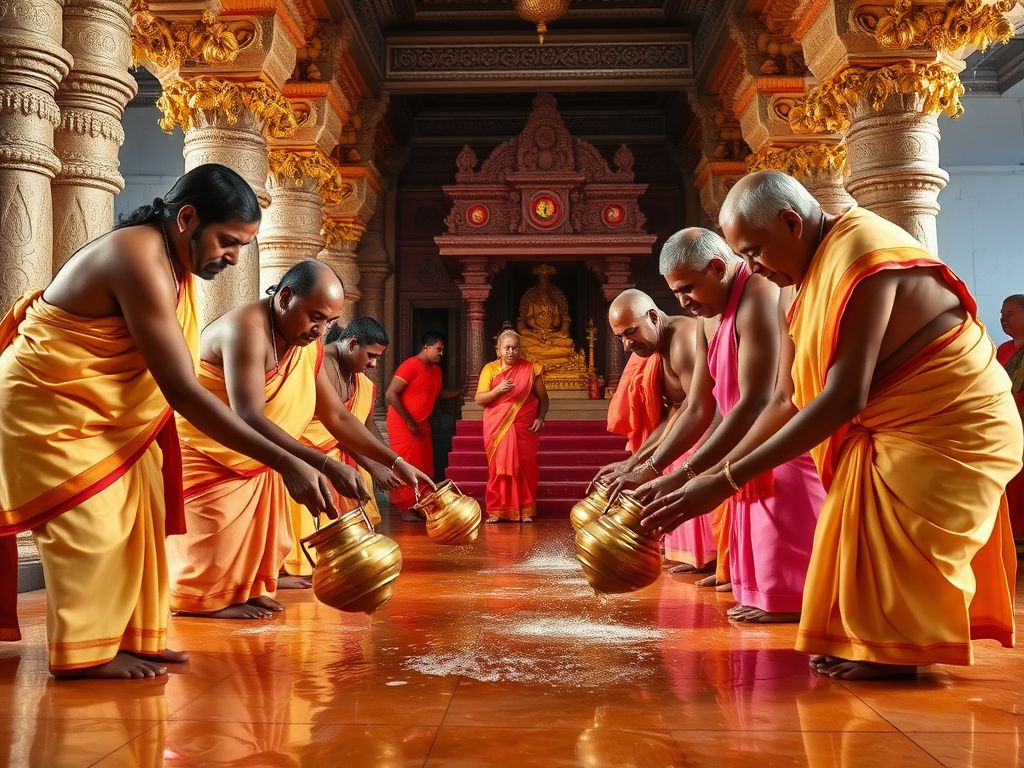
Four times every year, the entire Tirumala temple complex undergoes a full ceremonial cleansing before it greets another cycle of major festivals. This ritual is called Koil Alwar Tirumanjanam, and it is among the most thorough acts of devotion that Tirumala Tirupati Devasthanams carries out on behalf of all pilgrims. Every corner of the temple, from the innermost sanctum to the open courtyards, the towering mandapams, and the processional vahanas, is washed, purified, and formally re-consecrated by senior archakas (hereditary priests). For any pilgrim planning a visit, knowing when this ritual falls and what it means for darshan timing is essential. Specific dates are announced one to two weeks in advance on news.tirumala.org.
Speaking plainly, this is one ritual that rewards a little advance research: arriving on the day of a Koil Alwar Tirumanjanam without knowing it is happening can mean a long wait and no darshan until the afternoon.
Table of Contents
What the name means
The three Tamil-Sanskrit words together describe the ritual precisely:
- Koil (Tamil) means temple.
- Alwar refers to the devotee-saints of the Vaishnava tradition, and by extension the entire sacred edifice that houses the presiding deity.
- Tirumanjanam means sacred bath or ceremonial cleansing, the same term used when the deity’s idol is bathed with consecrated ingredients.
Put together, the name translates as “sacred cleansing of the temple.” Unlike the daily abhishekam performed on the idol alone, the Koil Alwar Tirumanjanam extends the concept of ritual purification to the building itself: walls, pillars, floors, vahana repositories, and every subsidiary shrine within the complex.
Why the ritual is performed
In Agama Shastra, the ancient body of temple science that governs the construction and maintenance of Vaishnava temples, a consecrated structure accumulates ritual impurity over time through the sheer volume of human activity: thousands of pilgrims daily, oil lamps burning, flower garlands decaying, and months of continuous worship. The temple is not merely a building; Agamic tradition holds it to be a living sacred body. Just as the deity receives a ritual bath each morning, the entire temple body requires periodic deep cleansing to restore its full sanctity.
This is not symbolic housekeeping. The cleansing is paired with the re-chanting of Vedic mantras to formally re-establish the divine presence throughout every part of the structure. Only after this re-consecration is the temple considered fully ready to host a major festival where tens of thousands of pilgrims will gather over several days.
When Koil Alwar Tirumanjanam is held
The ritual is conducted four times a year, timed to precede the temple’s largest festivals:
- Before Salakatla Brahmotsavam, the flagship nine-day festival, typically held in September or October. Preparation for this scale of celebration requires the entire temple to be at its highest ritual purity.
- Before Pavithrotsavam, the August festival during which golden pavithras (sacred rings) are placed on the deity. The cleansing immediately prior underscores the heightened purity the occasion demands.
- Before Vaikuntha Ekadasi, the December-January occasion when the Vaikunta Dwaram (the northern gate) is ceremonially opened and enormous crowds converge on Tirumala.
- One additional quarterly cleansing to maintain the annual ritual cycle independent of festival timing.
TTD announces the exact dates one to two weeks ahead of each occurrence. The most reliable place to check is the official news portal at news.tirumala.org. For seva bookings around these dates, the TTD online portal at ttdsevaonline.com will typically show service availability for the days surrounding a Tirumanjanam.
What the ritual involves
The cleansing begins before dawn and follows a precise sequence set out in the Agamic texts:
- Pre-dawn preparation: priests gather sacred ingredients including sandalwood paste, turmeric, herbs, milk, curd, ghee, honey, sugar, fruits, and water drawn from the temple’s own consecrated wells.
- Sanctum cleansing: the inner sanctum (garbhagriha) is ritually washed with the traditional ingredients in a prescribed order, mantras accompanying each stage.
- Mandapam and courtyard cleansing: all mandapams, prakara (circumambulatory) corridors, and open courtyards are gone through systematically by teams of archakas.
- Vahana cleansing: the processional vahanas stored in the temple, the sculptural vehicles used during Brahmotsavam processions, are also ritually cleaned and inspected.
- Re-consecration: Vedic mantras are chanted to formally restore divine presence throughout the cleansed areas.
- Closing aarti: a final aarti marks the completion of the ritual and signals that the temple is ready to reopen.
The full process takes most of the day. The temple is typically closed for normal darshan from 6 AM to 2 PM on the day of the cleansing. Both Sarva Darshan queues and Special Entry Darshan are suspended during this window, and no Arjitha Sevas are conducted inside the sanctum while the cleansing is in progress. Daily sevas such as Suprabhata Seva in the early morning and evening sevas later in the day generally continue on either side of the closure window, though pilgrims should confirm the exact schedule for the specific date.
Planning your visit around Koil Alwar Tirumanjanam
A fair warning for pilgrims who have travelled long distances: do not arrive at the hill without checking whether a Tirumanjanam is scheduled for that day. The closure runs through the morning hours when most pilgrims prefer to complete darshan, and queues on the day after cleansing can be longer than usual because of accumulated pilgrims.
The most practical approach:
- Check news.tirumala.org in the week before your intended visit. TTD posts Tirumanjanam notices under temple news and updates.
- If you are travelling by train, irctc.co.in allows you to adjust booking dates once the temple calendar is confirmed.
- Consider planning your visit for the day after a Koil Alwar Tirumanjanam rather than avoiding it entirely. Many experienced pilgrims deliberately time their darshan to the day following the cleansing, when the temple carries the fresh atmosphere of a fully re-consecrated space.
- Sponsorship of portions of the ritual is available to major donors; it is not an Arjitha Seva open to general booking. Inquiries should be directed to TTD administration rather than the standard seva booking portal.
Common questions
Is the temple closed for the entire day? No. The closure is typically from 6 AM to 2 PM. Suprabhata Seva in the early hours and evening sevas later in the day generally proceed normally. Confirm the schedule for your specific date on news.tirumala.org.
Can pilgrims watch the cleansing? The internal cleansing inside the sanctum and mandapams is not open to the public. Closing aartis and other ceremonies visible from outside the inner precinct may be accessible to pilgrims present at the temple after reopening.
Is photography allowed during the ritual? Photography of the internal cleansing is not permitted. Photography outside the temple premises follows standard guidelines.
How many times a year does Koil Alwar Tirumanjanam take place? Four times a year, before Salakatla Brahmotsavam, before Pavithrotsavam, before Vaikuntha Ekadasi, and once as a quarterly interval cleansing.
Will my Arjitha Seva booking be honoured on the day of Tirumanjanam? Arjitha Sevas conducted inside the sanctum are suspended during the cleansing window. TTD typically makes arrangements for affected bookings; contact TTD via ttdsevaonline.com if your seva falls on a notified Tirumanjanam date.
Where is the announcement made? TTD announces Koil Alwar Tirumanjanam dates on news.tirumala.org, usually one to two weeks before each occurrence.
Is there a charge to be present at Tirumala on this day? The standard darshan access rules apply. There is no additional charge, but normal darshan is suspended during the cleansing hours.
Related reading
- Salakatla Brahmotsavam Master
- Dwajarohanam, Flag Hoisting
- Chinna Sesha Vahanam
- Kalpavruksha Vahanam
- Sarva Bhoopala Vahanam