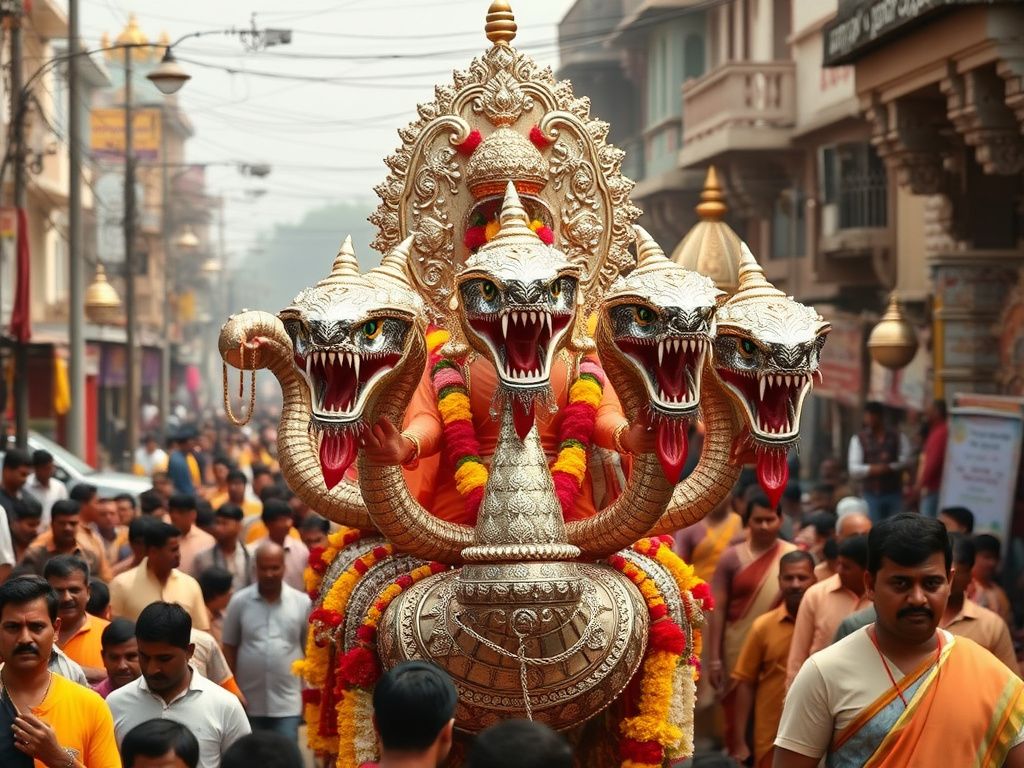
Among the nine days of Salakatla Brahmotsavam at Tirumala, few moments carry the quiet weight of the Chinna Sesha Vahanam. On Day 2 morning, before the sun clears the Eastern Ghats, Sri Malayappa Swamy, the silver processional idol of Lord Venkateswara, is carried through the four mada streets seated on Chinna Sesha, the five-hooded serpent mount. The procession typically begins at 7:00 AM and lasts approximately 90 minutes, covering a route of approximately 1.8 km. For what it’s worth, this is one of the few Brahmotsavam processions where the crowd thins just enough to let you watch in genuine stillness rather than in a press of thousands.
The name itself tells the story: chinna means small or young in Telugu; sesha refers to Adisesha, the primordial serpent of Vaishnava cosmology. This is the smaller of the two Sesha vahanas in the festival. Its companion, Pedda Sesha Vahanam, takes place on Day 1 night. Together they open Brahmotsavam by declaring, in visual and symbolic terms, that the lord worshipped on this hill is none other than Vishnu himself.
Table of Contents
Adisesha and the Vaishnava cosmos
To understand why Brahmotsavam begins with serpent vahanas, it helps to understand Adisesha’s place in Vaishnava thought. Adisesha is the divine serpent upon whom Lord Vishnu rests during the intervals between cosmic cycles. He is not merely a mount but a companion, present wherever Vishnu manifests on earth. The Puranas describe him as carrying the entire weight of creation on his hoods and yet remaining utterly calm. That image of effortless, devoted support is exactly what the Sesha vahana conveys during the procession.
Adisesha is typically depicted with multiple hoods forming a canopy above the lord. The Brahmotsavam tradition at Tirumala distinguishes between two forms:
- Pedda Sesha Vahanam (Day 1 night), “Large Sesha, ” the seven-headed throne form, grand and imposing
- Chinna Sesha Vahanam (Day 2 morning), “Small Sesha, ” the five-headed simpler form, quieter and more intimate
Both vahanas carry Sri Malayappa Swamy along identical streets, but the mood differs. Pedda Sesha, lit by night lamps, has a ceremonial grandeur. Chinna Sesha, in the morning light, feels closer to a private darshan in open air.
The procession route
Chinna Sesha Vahanam follows the standard circuit around the four mada streets surrounding the main temple:
- The procession starts at the Mahadwaram (main entrance)
- Proceeds along East Mada Street
- Turns into North Mada Street
- Continues along West Mada Street
- Returns via South Mada Street back to the temple
The total route length is approximately 1.8 km and the pace is slow and ceremonial, allowing devotees along the street to have extended sight of the deity. The best vantage point for those who want to see the vahana emerge from the temple is East Mada Street, positioned between 7:30 and 8:00 AM. The corner where East Mada Street meets North Mada Street offers a natural turning angle, photography is permitted on the mada streets, though never inside the temple sanctum.
The vahana and its decoration
The Chinna Sesha vahana is crafted as a compact serpent form with five hoods arching upward. Sri Malayappa Swamy is seated at its centre, and the overall structure is adorned with care appropriate to the early-morning hour:
- Silver and gold ornaments on the serpent body
- Fresh flower garlands draped over the hoods
- Traditional silk cloth as backdrop
- Brass lamps lit on either side
- Devotees walking alongside, chanting bhajans
The soundscape of the procession is as distinctive as the sight. Vedic mantras are chanted by accompanying pundits; Annamacharya keertanas are sung by SVBC artists; periodic conch blasts and bell ringing mark the turns in the route. Throughout, the crowd responds with “Govinda! Govinda!” and traditional Nadaswaram and drum accompaniment carries across the streets.
Attending the procession
Watching Chinna Sesha Vahanam requires no ticket and no advance registration for those who line the mada streets. The procession is public, and free spectator viewing from the streets is open to all. TTD does offer reserved stand seats with a direct route view, which can be booked 30 to 60 days ahead of the festival. The vahana itself has sponsorship slots, devotees interested in sponsoring can check the TTD portal under Arjitha Sevas during the festival period.
I’ll be upfront: Brahmotsavam dates shift each year according to the Telugu calendar, and the precise Day 2 morning timing should always be confirmed from the official schedule rather than assumed. The most reliable place for current Salakatla Brahmotsavam vahana timings is news.tirumala.org, which publishes the daily programme before the festival begins. The full TTD calendar and seva bookings are available at ttdsevaonline.com.
Pilgrims travelling from other states can check train options at irctc.co.in for routes to Tirupati, and those coming by road can check APSRTC services at apsrtconline.in for buses from Tirupati to Tirumala.
Chinna Sesha in the wider festival arc
Brahmotsavam spans nine days, and every day features morning and evening vahanas. Chinna Sesha Vahanam on Day 2 morning is paired with Hamsa Vahanam (the swan mount) on Day 2 evening, giving a single day two contrasting moods: the ancient serpent in morning light, the graceful swan at dusk. Later in the festival, Day 5 brings the famous Garuda Vahana Seva, which draws the largest single-day crowd of the nine days. Knowing where Chinna Sesha sits in this sequence helps pilgrims plan which processions to prioritise.
Common questions
What is the difference between Chinna Sesha and Pedda Sesha Vahanam? Pedda means large and Chinna means small. Pedda Sesha is the seven-headed form and takes place on Day 1 night; Chinna Sesha is the five-headed form and takes place on Day 2 morning. They are two distinct vahana models with different ritual contexts, though both serve to establish Sri Venkateswara as Vishnu resting on his eternal companion.
What time does Chinna Sesha Vahanam begin? The procession typically begins at 7:00 AM and lasts approximately 90 minutes, finishing before 9:00 AM. Exact timings vary by year and should be confirmed at news.tirumala.org.
Is photography allowed during the procession? Photography is permitted on the mada streets and along the open route. It is never permitted inside the temple sanctum or in restricted TTD areas.
Can children attend Chinna Sesha Vahanam? Yes. Children attend alongside families in the procession crowd. The event is festive but the streets can be crowded, so plan for this when arriving with young children.
Is the daily Arjitha Brahmotsavam the same as Chinna Sesha Vahanam? No. The daily Arjitha Brahmotsavam is a year-round small-scale ritual available most days. The Chinna Sesha Vahanam is specifically the Day 2 morning procession during the annual Salakatla Brahmotsavam, a much larger public event on a defined date each year.
How long is the procession route? The route covers approximately 1.8 km around the four mada streets, at a slow ceremonial pace.
Where is the best spot to watch? East Mada Street between 7:30 and 8:00 AM gives a good view of the deity emerging from the temple. The corner where East Mada Street meets North Mada Street provides a natural angle for viewing the turn.
Related reading
- Salakatla Brahmotsavam Master
- Dwajarohanam, Flag Hoisting
- Kalpavruksha Vahanam
- Sarva Bhoopala Vahanam
- Garuda Vahana Seva (Day 5)