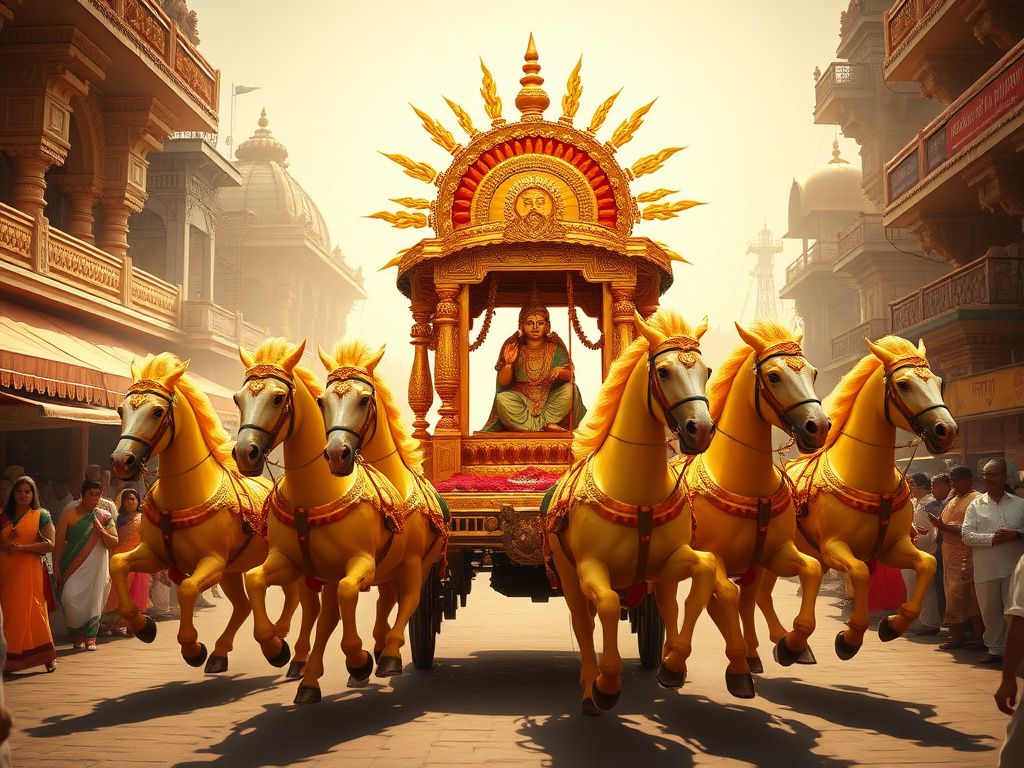
Among the nine vahanas paraded during the Salakatla Brahmotsavam at Tirumala, the Suryaprabha Vahanam holds a singular place on Day 7. The morning procession begins at approximately 7:00 AM, when Sri Malayappa Swamy, the processional form of Lord Venkateswara, is seated on a chariot built in the image of the sun god Surya’s celestial vehicle. Seven symbolic horses draw the chariot, each horse representing one day of the week, and gold sun-rays radiate behind the raised throne. It is Day 7’s defining spiritual moment, completed by a complementary night procession when the same Lord rides the Chandraprabha, the moon chariot, at around 7:30 PM. Together the two vahanas frame Day 7 as the “celestial day” of Brahmotsavam, sun governing the morning, moon presiding over the night.
The detail I’d flag for pilgrims planning around this vahana is the 90-minute duration of the procession: the route covers all four mada streets, and the early passage along East Mada Street between 7:15 and 7:45 AM offers the best combination of morning light and clear sightlines for photography or simply for viewing.
Table of Contents
What the Suryaprabha Vahana is and why it matters
The name Suryaprabha means “radiance of the sun.” In Vaishnava cosmology, Surya is one of the Navagrahas, the nine celestial bodies, and all nine operate as agents of Lord Vishnu’s cosmic order. The Suryaprabha vahana makes that theological point visible. By riding the sun’s own chariot, Sri Malayappa Swamy affirms Vishnu’s sovereignty over the forces that illuminate and sustain the world.
The construction of the vahana reflects that purpose at every level:
- Chariot-style structure with a raised throne at the centre
- Seven symbolic horses drawing the chariot, representing the seven days of the week
- Gold sun-rays fanning outward from behind the throne
- Torches, lamps, and reflective surfaces arranged to amplify the visual impression of solar brilliance
- Sri Malayappa Swamy dressed in full royal attire appropriate to the celestial context
The symbolism reinforces three ideas that run through the Brahmotsavam as a whole: Vishnu’s command over the celestial bodies, the illumination of the world as a direct expression of divine will, and the cycle of day and night as part of a single cosmic rhythm the Lord maintains.
Day 7 as the celestial day of Brahmotsavam
Brahmotsavam runs across nine or ten days depending on the year, and each day is paired with specific vahanas that carry theological weight. Day 7 is structured around the celestial pairing of sun and moon:
| Time | Vahana | Theme |
|---|---|---|
| Morning (7 AM) | Suryaprabha | Sun’s radiance, day’s illumination |
| Night (7:30 PM) | Chandraprabha | Moon’s coolness, night’s serenity |
Both processions follow the same four-mada-street route. Attending both on a single day gives a pilgrim the full arc, the heat and brilliance of the solar chariot in the morning, the cooler, silver quality of the moon chariot after dark. For those who can manage only one, the morning Suryaprabha procession is the more photographically striking because of the interplay between the torchlight, reflective gold surfaces, and natural daylight.
The Rathasaptami connection
The Suryaprabha vahana appears in a second annual context beyond Brahmotsavam. On Rathasaptami, the festival in February that honours Surya directly, Sri Malayappa Swamy is taken out on seven different vahanas in a single day, and the Suryaprabha is among them. The Brahmotsavam appearance and the Rathasaptami appearance use the same vahana, and both carry equal devotional standing.
This creates a practical benefit: pilgrims who cannot travel to Tirumala during Brahmotsavam (which changes dates each year based on the Telugu calendar) have a second annual window in February to see Sri Malayappa Swamy on this vahana. The Rathasaptami date is tied to the solar calendar and tends to fall in late January or mid-February. Confirm the exact date each year through news.tirumala.org, which publishes the festival calendar well in advance.
How to attend the Suryaprabha procession
The mada streets around the Tirumala temple are public space during processions, so the majority of pilgrims watch the Suryaprabha Vahanam as free spectators. Reserved seating in TTD-managed paid stands is available, and booking generally needs to be done around 30 days ahead of the procession date. Details and availability can be checked through ttdsevaonline.com.
For pilgrims travelling from outside Andhra Pradesh, train bookings to Tirupati (the base town at the foot of the hill) are handled through irctc.co.in, and APSRTC operates regular bus services from several major cities to Tirupati, bookable at apsrtconline.in. From Tirupati, TTD runs its own bus fleet up to Tirumala.
For pilgrims who cannot be physically present, SVBC TV and its YouTube channel carry a live broadcast of the procession.
One limitation to be straight about: Brahmotsavam dates shift each year with the Telugu lunar calendar, so no fixed date can be given here. Always check the official calendar on news.tirumala.org before making travel bookings.
Practical tips for the best viewing experience
The procession begins at approximately 7:00 AM and covers the full circuit of four mada streets over roughly 90 minutes. Arriving at East Mada Street by 7:15 AM positions spectators well for the early passage, which benefits from natural morning light and typically draws a slightly thinner crowd than the main northern street.
Photography is permitted on the mada streets. Inside the temple precincts, photography is not allowed. The torch and lamp arrangement on the Suryaprabha chariot catches well in morning light, so the early stretch of the procession tends to be the most photogenic.
Crowds during Brahmotsavam are substantial. Arriving well before 7:00 AM to secure a position along the route is advisable, particularly on Day 7, which draws many pilgrims specifically for the celestial-vahana pairing.
Common questions
Is Suryaprabha the same vahana as Garuda Vahana? No. Suryaprabha is the sun chariot, held on Day 7 morning. Garuda Vahana is the eagle vahana, held on Day 5 night. They carry distinct theological themes and serve different moments in the festival sequence.
Can I see Suryaprabha outside of Brahmotsavam? Yes. Rathasaptami in February is the other annual occasion when Sri Malayappa Swamy is taken on the Suryaprabha vahana. It is one of seven vahanas used on that single Rathasaptami day.
How long does the Suryaprabha procession last? Approximately 90 minutes, covering the four mada streets around the temple.
Is photography allowed during the procession? Photography is permitted on the mada streets. It is not permitted inside the temple itself.
Where should I stand for the best view? East Mada Street between 7:15 and 7:45 AM gives good morning light and catches the early passage of the procession before the full crowd density builds.
What is the significance of the seven horses? The seven horses represent the seven days of the week. In the iconography of Surya’s chariot, the seven horses are a standard element, and the Suryaprabha vahana at Tirumala follows that classical form.
How do I confirm the Day 7 date for the current year? Brahmotsavam dates follow the Telugu lunar calendar and change each year. The TTD news site at news.tirumala.org publishes the confirmed schedule each year before the festival begins.
Related reading
- Salakatla Brahmotsavam Master
- Dwajarohanam, Flag Hoisting
- Chinna Sesha Vahanam
- Kalpavruksha Vahanam
- Sarva Bhoopala Vahanam