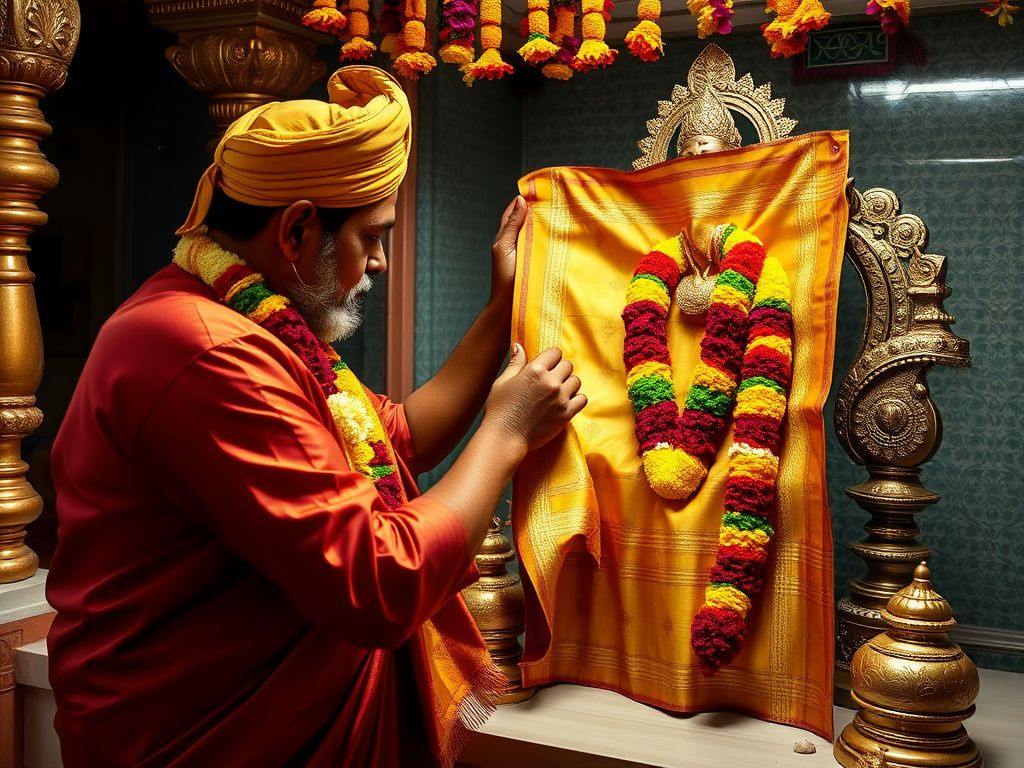
Every Friday morning at Tirumala, well before the main darshan crowds gather, a cluster of devotees assembles near the Supadam Q gate for Vastralankara Seva, the formal ceremony in which Lord Venkateswara is dressed in elaborate silk vastram and adorned with ornaments following his weekly Abhishekam. For most pilgrims who visit Tirumala on any given day, they see the deity as he appears after this ceremony. Vastralankara Seva gives a small group of sponsoring devotees the privilege of witnessing that transformation from close quarters, at the Bangaru Vakili area, before the sanctum opens to the general public.
The ticket cost is Rs. 220 per person, placing it among the more accessible of TTD’s Arjitha Sevas. Yet accessibility does not diminish its significance, the Vastralankara on Friday carries a particular spiritual weight because Friday itself is the day of Sri Mahalakshmi in the Hindu weekly calendar, and Tirumala’s rituals on that day are structured around that connection.
Table of Contents
Why Friday Holds Special Significance
In the Hindu tradition, Friday (Shukravar) is associated with the goddess Sri Lakshmi. At Tirumala, this connection shapes the entire weekly ritual structure. The deity’s formal Abhishekam, the ceremonial bathing with sanctified waters, milk, and other offerings, is performed only once a week, and that day is Friday. The Vastralankara that follows is therefore not a routine redressing but the first adornment of a freshly bathed Lord Venkateswara for the week ahead.
Friday at Tirumala is also the day on which the Thomala Seva is rescheduled to 7–8 AM, later than on other days, specifically to accommodate the Abhishekam and Vastralankara sequence. The Tiruchanoor temple’s special Friday Pooja for Sri Padmavathi also runs in parallel. Together, Friday at Tirumala is the most ritual-intensive day of the week.
What Happens During the Ceremony
Vastralankara Seva begins after the Friday morning Abhishekam, around 7:00 AM. Sponsoring devotees who have purchased tickets must report by 6:00 AM at the Supadam Q gate, one full hour before the ceremony, to allow time for verification and positioning.
The ceremony itself proceeds in a sequence familiar to regular pilgrims but deeply moving to witness in person:
- The deity, after the weekly Abhishekam, is dressed in elaborate silk vastram sourced from traditional weavers
- Selected ornaments are placed, including the golden crown, garlands, and ornaments on the deity’s hands, with the specific combination varying by ritual day
- Sandalwood paste and kumkum are applied
- Sponsoring devotees witness the ceremony from the Bangaru Vakili area
- A concluding aarti is performed, followed by prasadam distribution
Devotees who attend Vastralankara Seva receive: a witness view of the ceremony from the Bangaru Vakili area, Special Entry Darshan after the ceremony concludes, two laddus, and a small piece of the previous day’s vastram. That final item, a fragment of cloth that had dressed the deity, is considered among the most sacred forms of prasadam at Tirumala and is typically kept on a home pooja altar or treated as a protective amulet.
The Vastram Tradition at Tirumala
The silk used in Tirumala’s Vastralankara is not ordinary temple cloth. TTD maintains long-term contracts with certified weavers from the Conjeevaram and Pochampally traditions, two of South India’s oldest and most technically demanding weaving lineages. The specifications are strict:
- Pure mulberry silk, verified for quality
- Traditional border patterns drawn from established devotional motifs
- Specific colour requirements, cream, gold, and certain devotional reds feature prominently
- Hand-loom weaving by weavers recognised under TTD’s supply agreements
Each piece used in the ceremony costs significantly more than commercial silk of comparable weight, because the production process combines material quality with ritual compliance at every stage. In practice, the cloth that emerges from this process is not merely textiles, it is considered fit for divine contact, and its subsequent distribution as prasadam reflects that status.
Worth flagging for first-time attendees: the vastram piece distributed as prasadam is from the previous day’s vestment, not the one placed on the deity during the ceremony you are witnessing. This is standard TTD practice and does not diminish the prasadam’s sacred standing.
The Sri Padmavathi Connection
Friday’s significance at Tirumala extends to the Tiruchanoor temple, about 5 kilometres from Tirupati, where Sri Padmavathi, the consort of Lord Venkateswara, is worshipped. The temple conducts its own special Friday Pooja with a parallel vastralankara for the goddess. Many pilgrims who attend Vastralankara Seva at Tirumala in the morning complete their Friday pilgrimage with an evening visit to Tiruchanoor, treating the two temples as a single day’s circuit.
Dress Code and Practical Preparation
TTD enforces a strict traditional dress code for all Arjitha Seva participants. For Vastralankara Seva, men must wear a dhoti with angavastram; women must wear a saree with blouse. Western clothing, trousers, shorts, and sleeveless garments are not permitted at the reporting gate. Arriving in the correct attire before 6:00 AM avoids delays at the queue gate.
For booking, visit ttdevasthanams.ap.gov.in and navigate to Arjitha Sevas, then select Vastralankara Seva to view available Friday slots. Quota for the first Friday of a given month is typically released on a schedule published on the site. Tickets cost Rs. 220 per person and are paid through the standard TTD payment gateway. You can also monitor quota announcements and official schedule updates at news.tirumala.org.
Pilgrims travelling from other states can plan train journeys to Tirupati station via irctc.co.in and connect to Tirumala by APSRTC bus from Tirupati bus stand, bookable through apsrtconline.in.
Common Questions
Is Vastralankara Seva performed on any day other than Friday? The formal Vastralankara as a sponsorable Arjitha Seva is Friday-only at Tirumala. While the deity is redressed as part of daily Thomala Seva on other days, the post-Abhishekam Vastralankara ceremony with its full ritual sequence occurs only on Fridays.
What time must I report and where? Devotees must report by 6:00 AM at the Supadam Q gate. The ceremony begins after the Abhishekam, approximately at 7:00 AM, so one hour of processing time is required at the gate.
Can I keep the vastram piece received as prasadam? Yes. The piece of the previous day’s vastram distributed as prasadam is meant to be taken home. It is typically placed on a home pooja altar or kept as a sacred amulet.
What do ticket holders receive apart from witnessing the ceremony? Ticket holders at the Rs. 220 price receive a view of the Vastralankara from the Bangaru Vakili area, Special Entry Darshan after the ceremony, two laddus, and a small piece of the previous day’s sacred vastram.
Is there a dress requirement for women? Yes. Women must wear a saree with blouse. The dress code applies to all devotees attending the seva, not only to those performing any priestly function. Entry is refused at the gate for those not in traditional attire.
How far in advance can I book? TTD releases Vastralankara Seva quota on a rolling monthly schedule. The exact release dates are published on ttdevasthanams.ap.gov.in. Booking several weeks ahead is advisable, particularly for high-demand Fridays during festival months.
Is this the same as the daily Thomala Seva? No. Thomala Seva is a separate daily seva involving garland decoration, performed each morning. Vastralankara Seva is a distinct Friday ceremony that follows the weekly Abhishekam and involves the full silk-cloth dressing ritual. On Fridays, Thomala Seva itself is rescheduled to 7–8 AM to follow the Abhishekam sequence.
Related Reading
- Kalyanotsavam Seva Booking
- Suprabhata Seva Booking
- Sahasra Deepalankarana Seva
- Ekantha Seva (Midnight)
- Unjala (Dolotsavam) Seva