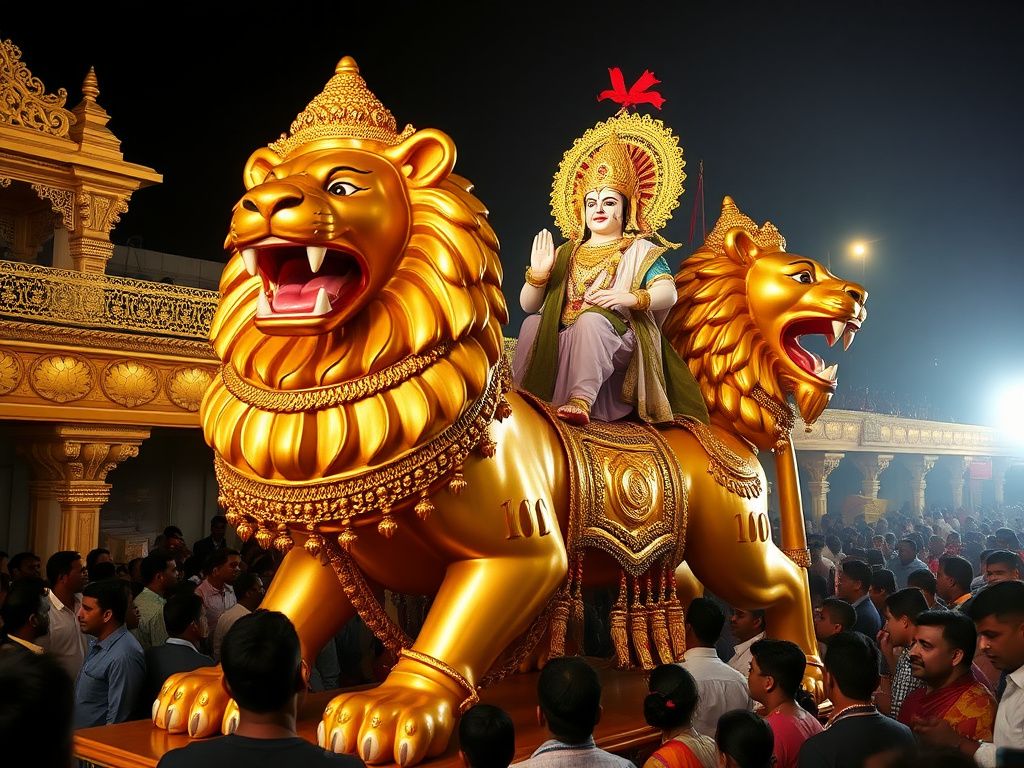
On the third-day morning of the Tirumala Brahmotsavam, Lord Malayappa Swamy is taken in procession on the Simha Vahanam, a golden lion. Among the sixteen vahana sevas of the nine-day festival, the lion carries the symbolism of supreme royal power, fearless courage, and the conquest of the untamed animal nature within. It is the morning the festival turns from gentle imagery, the serpent and the swan, toward raw, protective strength. This guide covers the symbolism, where Simha Vahanam sits in the sequence, what the morning is like, and how to witness it.
Table of Contents
What the lion symbolises
- Royalty and power: the lion is king of the animal kingdom, so riding it signifies the Lord’s supreme sovereignty.
- Courage and fearlessness: the lion stands for the fearless protector who removes the devotee’s fear.
- Conquest of the ego: the lion also represents the untamed animal nature, and the Lord seated upon it shows mastery over the lower self.
- The Narasimha link: the lion evokes Lord Narasimha, Vishnu’s fierce man-lion avatar who protects devotees and destroys evil.
Taken together, the Simha Vahanam reminds devotees that the Lord is the king of kings, and that surrendering to Him is what tames the wildness of the restless mind.
Where it sits in Brahmotsavam
The Simha Vahanam is the third-day morning procession. It follows the Sesha Vahanam on Day 1 and the Chinna Sesha and Hamsa Vahanams on Day 2, and it precedes the Muthyapu Pandiri Vahanam on the Day 3 night. Each vehicle across the nine days reveals a different face of the Lord’s glory, and the lion is the one that most directly expresses His protective power.
What the morning is like
The deity, richly adorned in fresh garlands and golden vastram, is mounted on the golden lion and carried along the four mada streets that ring the temple. Because it is a morning procession, the Simha Vahanam unfolds in daylight, which gives a clear, detailed darshan of the intricately crafted lion and the resplendent Lord. Vedic chanting and traditional music move with the procession, and the mada-street viewing lanes are the same ones used on the bigger vahana days.
For what it’s worth, the morning vahanas like Simha are the ones I’d recommend to anyone who finds the evening crowds overwhelming. The daylight makes the craftsmanship of the vehicle far easier to actually see, and the Day 3 morning crowd is gentler than the Day 5 Garuda crush, so you can take it in properly.
How to witness it
- The procession is held in the public mada streets and is free for all devotees.
- Arrive early for a good spot, and carry water and a cap, since the morning sun on the open streets gets warm.
- Premium arati viewing may be available through advance Arjitha Seva booking.
- Photography of the procession, outside the temple, is generally permitted.
Common questions
What does the lion symbolise? Royal power, courage, fearlessness, and the conquest of the ego.
Which day is Simha Vahanam? The third-day morning of Brahmotsavam.
Is it connected to Narasimha? Yes, the lion evokes the man-lion avatar Narasimha, reinforcing the protective, fierce-yet-loving aspect of the Lord.
Do I need a ticket? No, the procession is free in the public mada streets.
How is the morning procession different from an evening one? Daylight gives a clearer view of the vehicle and the deity, and morning crowds tend to be lighter than the big evening processions.
When is the 2026 Brahmotsavam? Salakatla runs 15 to 23 September 2026, and a second Navaratri Brahmotsavam runs 12 to 20 October 2026 because of the Adhika Masa.
Can I see more than one vahana in a day? Yes. On several Brahmotsavam days there is both a morning and an evening procession, so with a little planning you can witness two vahanas in a single day along the mada streets.
Where is the best place to stand? The same mada-street viewing lanes used on Garuda day apply; the East street faces the temple entrance and fills first, while the North and West streets are usually less packed on a morning procession like this.
Related reading
- Hamsa Vahanam: Day 2 of Brahmotsavam
- Garuda Vahanam: Day 5 of Brahmotsavam
- Tirumala festival calendar 2026
One honest caveat: the exact start time shifts on the day with the temple schedule, so treat the morning slot as approximate and check the festival-day timings rather than fixing your plans to a clock. For the vahana schedule, see news.tirumala.org and tirumala.org.