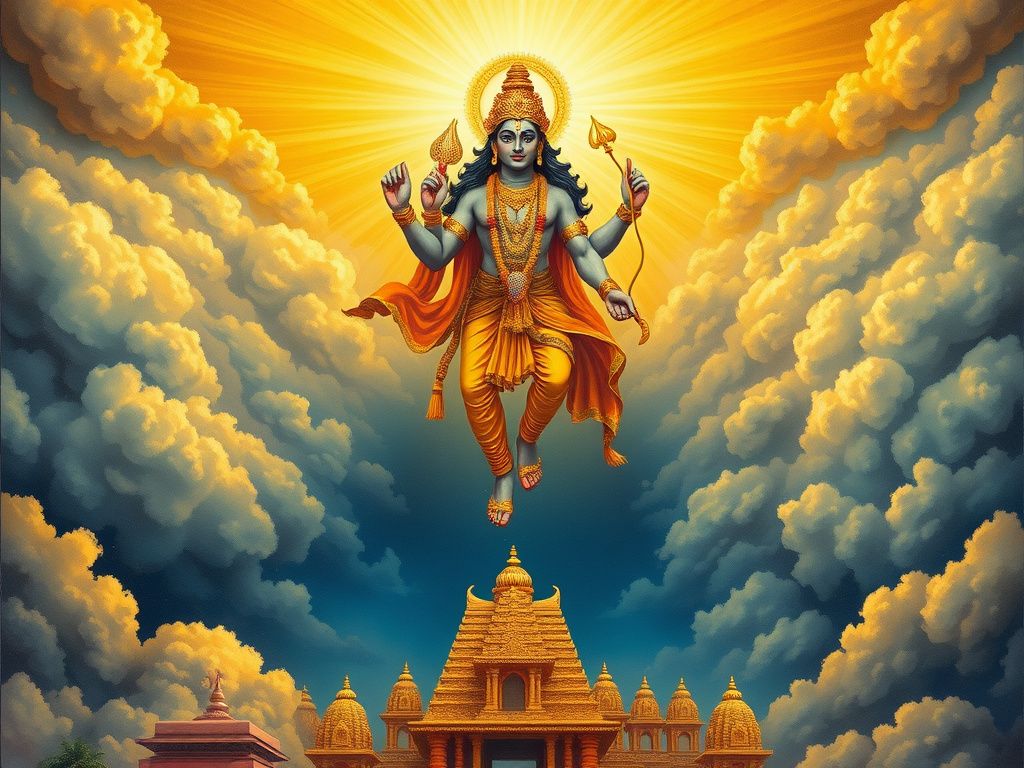
Of all the questions devotees ask about Tirumala, one of the most profound is why Lord Vishnu chose to descend and remain here specifically during the Kali Yuga, the present age. The answer sits at the heart of Tirumala’s theology: the doctrine of the Lord’s boundless compassion for humanity in its most spiritually difficult era. This article explains the traditional understanding of why Sri Venkateswara made the Seven Hills His earthly home, and why that idea quietly shapes everything a pilgrim experiences there.
Table of Contents
The four yugas and the Kali Yuga
Hindu cosmology describes four ages that cycle in turn: Satya (Krita) Yuga, Treta Yuga, Dwapara Yuga, and Kali Yuga. The Kali Yuga is the present age, described in the scriptures as the time of greatest spiritual difficulty, when dharma is weakest and human beings find it hardest to reach liberation through the demanding practices of the earlier ages. It is the backdrop against which the Tirumala tradition reads the Lord’s descent.
The Lord’s compassionate solution
In earlier yugas, the tradition holds, people could reach the Lord through intense penance, elaborate yajnas, and direct meditation. In the Kali Yuga those paths became too hard for ordinary souls. Out of supreme compassion, karunya, Lord Vishnu chose to make Himself directly and physically available, descending to Earth and remaining present in a visible, accessible form so that even the spiritually weakest soul of this age could reach Him through simple darshan and surrender.
This is why Sri Venkateswara is called the Kali Yuga Pratyaksha Daivam, the directly perceivable God of the Kali Yuga. He does not demand the difficult disciplines of earlier ages; He asks only for sincere devotion and surrender.
Why Tirumala in particular
- The sacred Seven Hills: the Saptagiri is regarded as the manifest form of Adisesha, a naturally sacred dwelling for the Lord.
- The penance connection: the Sthala Purana describes Vishnu performing penance here after Lakshmi’s departure.
- The marriage to Padmavathi: the Lord’s earthly marriage rooted Him to this region permanently.
- Established sanctity: great sages and the divine vehicle Garuda are associated with consecrating the site.
The accessibility principle, made visible
Almost everything about the way Tirumala runs reflects this principle of accessibility in the Kali Yuga:
- Free Sarva Darshan, open to all regardless of status.
- Free meals through the Annaprasadam, so no devotee goes hungry.
- Simple surrender, saranagati, as the core path rather than complex ritual.
- The Lord standing in the giving posture, Varada, ready to bless.
For what it’s worth, this is the one piece of Tirumala theology I would read before a first darshan. Knowing the whole place is built on the idea of the Lord making Himself reachable changes how the long queue feels, from an ordeal to endure into the very point of being there.
The theological depth
In the Sri Vaishnava tradition this descent is understood through the idea of archa-avatara, the Lord making Himself present in the consecrated deity form so devotees can serve and worship Him directly. The Tirumala deity, in this understanding, is not a representation of the Lord; it is the Lord, fully present, choosing to remain accessible out of love for the souls of a difficult age. That is a large claim, and it is precisely the claim the tradition makes.
Common questions
What does Kali Yuga Pratyaksha Daivam mean? The directly perceivable God of the Kali Yuga, the Lord made physically accessible in this age.
Why is the Kali Yuga considered difficult? The scriptures describe it as the age when dharma is weakest and the older paths of penance and yajna are hardest to follow.
What is archa-avatara? The Sri Vaishnava concept of the Lord being fully present in the consecrated deity form for the sake of accessible worship.
Is darshan alone enough? The tradition holds that sincere darshan and surrender, saranagati, are the accessible path the Lord has opened for this age.
Does every tradition read it the same way? The broad idea is shared, though different acharyas emphasise different aspects of the descent and the deity’s presence.
Related reading
- The Sthala Puranam of Tirumala
- Saptagiri: the seven sacred hills
- Why are Lord Venkateswara’s eyes covered?
One honest caveat: this is the devotional and theological understanding of the tradition, not a historical or scientific claim, and I’ve kept to the mainstream Sri Vaishnava reading rather than any single commentator. For authoritative accounts, see tirumala.org and news.tirumala.org.