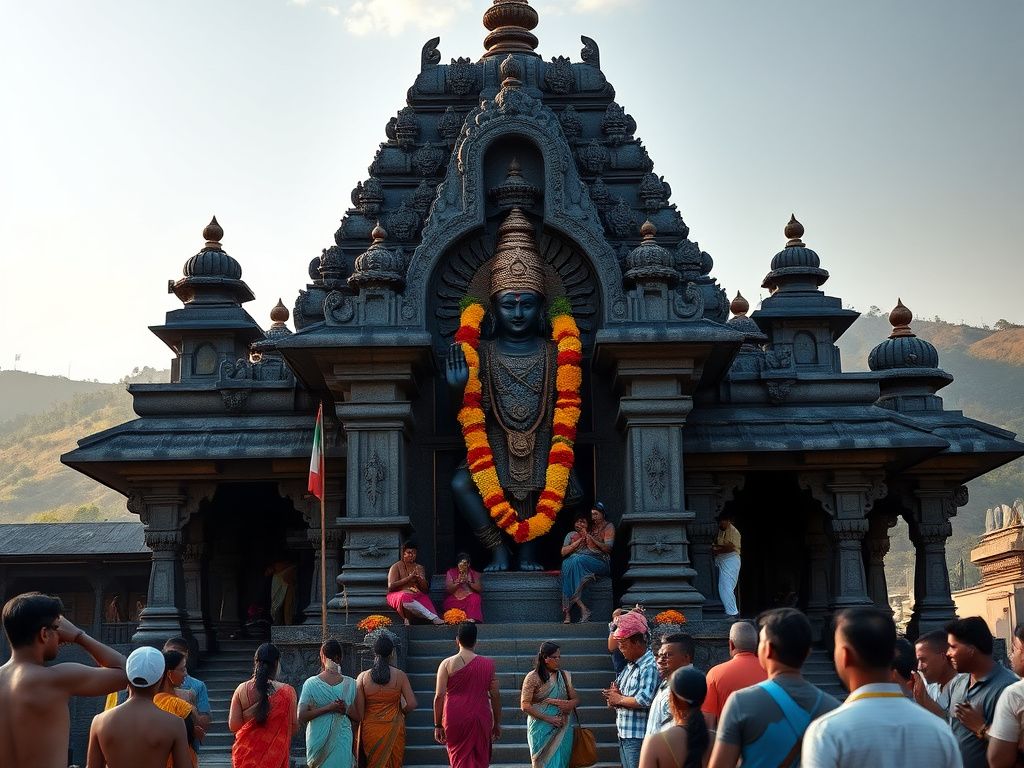
The Sri Kariya Manikya Swamy Temple at Nagari is an ancient Vishnu shrine in the Tirupati district of Andhra Pradesh, well off the main Tirumala trail. The name Kariya Manikya translates to black gem or dark ruby, a reference to the dark-hued form of Lord Vishnu worshipped here. For devotees who want to explore the lesser-known sacred sites of the Tirupati region, and especially for anyone travelling in from the Chennai side, this temple offers a calm, uncrowded darshan against the backdrop of the Nagari hills.
Table of Contents
About the temple
The shrine is dedicated to Lord Vishnu in the form of Kariya Manikya Swamy. The name comes straight from the deity’s dark stone form: kariya, meaning black or dark, and manikya, meaning gem or ruby, so the Lord here is venerated as the precious dark gem. The temple carries a long-standing local tradition and sits against the Nagari hills, a setting that gives the visit a quiet, contemplative feel quite different from the scale and bustle of Tirumala.
Location and setting
- Town: Nagari, in the Tirupati district of Andhra Pradesh.
- Setting: near the Nagari hills, known for the distinctive Nagari Nose, a rock formation that is a local landmark in its own right.
- Position: on the Tirupati-Chennai corridor, which makes it an easy stop for pilgrims approaching from the Tamil Nadu side.
Significance
- An ancient Vaishnava shrine that adds to the rich temple landscape around Tirupati.
- Devotees offer prayers for prosperity, well-being, and spiritual progress.
- The serene setting, away from the Tirumala crowds, lends itself to an unhurried, reflective darshan.
- It fits naturally into a wider devotional circuit for pilgrims who want to see more than one Vishnu temple on a trip.
The dark form of the deity is part of the appeal. In the Vaishnava imagination the Lord is often described as dark like a rain cloud or a deep gem, and a shrine whose very name celebrates that darkness gives the darshan here a distinct character worth experiencing once.
How to reach
- From Tirupati: by road via the Tirupati, Puttur, Nagari route.
- From Chennai: Nagari lies on the Chennai-Tirupati corridor and is reachable by road and rail; APSRTC runs services along this route.
- Nearest railway: Nagari railway station.
- Best combined with: a Tirupati pilgrimage, especially when approaching from Chennai.
For what it’s worth, I’d treat this as a stop woven into the drive rather than a destination in itself. On the Chennai-Tirupati road it is a calm, ten-minute darshan that breaks up the journey nicely; as a special trip out from Tirumala, it is a long way to go for a small shrine.
What to expect
Expect a modest, local temple rather than a grand complex: short or no queues on ordinary days, a quiet sanctum, and the kind of unrushed darshan that is hard to find at the major sites. Modest traditional dress is the norm, footwear is left outside, and as with most smaller shrines there may be a midday break in the timings.
Common questions
What does Kariya Manikya mean? Black gem or dark ruby, a reference to the dark-hued form of Lord Vishnu worshipped here.
Where is the temple? In Nagari town, Tirupati district, near the Nagari hills.
Can I combine it with Tirupati? Yes, especially when travelling from the Chennai direction, since Nagari sits on that route.
Is it crowded? Far less than Tirumala, which is much of its appeal; it offers a peaceful darshan.
What is the Nagari Nose? A distinctive rock formation in the Nagari hills, a recognisable local landmark near the town.
What are the timings? Confirm current timings locally, as smaller temples often have a lunch-break closure.
How much time should I allow? On a non-festival day, darshan here is quick, so half an hour to an hour is plenty, which is exactly why it works best as a short stop on a longer journey rather than a dedicated trip out from Tirumala.
Related reading
- Chennai to Tirupati travel guide
- Sri Chengalamma Parameswari temple, Sullurpeta
- Srikalahasti temple: timings and details
One honest caveat: this is a regional shrine without the centralised, published information of the big TTD temples, so timings and festival details are best confirmed locally before you travel. I’ve kept this guide to what is consistent across accounts rather than quoting specifics that change. For the wider region, Tirupati district tourism sources and tirumala.org are useful starting points.