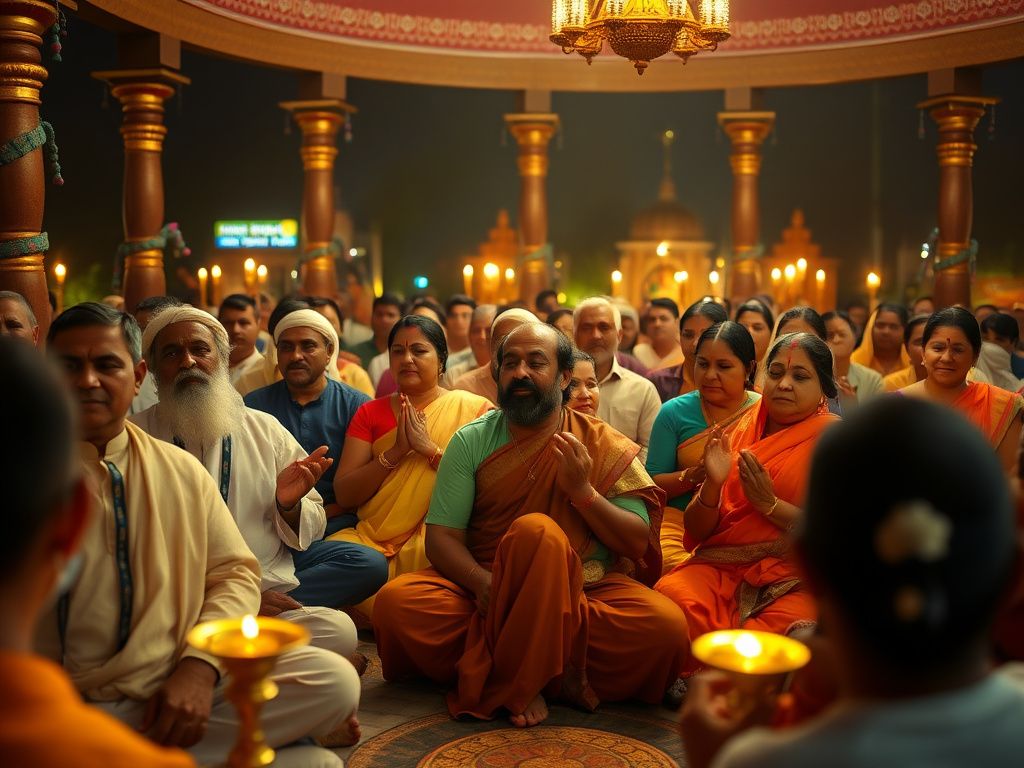
Somewhere between the formal rituals of the main temple and the solitary silence of a personal prayer, there exists a third kind of devotion: the collective voice. Govinda Nama Sankeertana at Narayangiri is that voice made continuous. It is the unbroken group chanting of Lord Venkateswara’s names, maintained around the clock, every day of the year, at the Narayangiri shrine on Tirumala hill. Pilgrims who discover it often call it the quietest surprise of the entire pilgrimage, not because the chanting is soft, but because the welcome is effortless and the entry point is just two syllables: Govinda.
For what it’s worth, sitting inside the sankeertana mandapam even for half an hour shifts something in the quality of a Tirumala visit in a way that is difficult to describe but easy to feel.
Table of Contents
What the Three Words Mean
The phrase breaks into three Sanskrit roots, each with its own weight.
- Govinda, One of the many names of Lord Vishnu and Sri Venkateswara, meaning “protector of cattle, ” connected to the Krishna avatar of the same deity.
- Nama, Names, specifically the divine names of the Lord.
- Sankeertana, Group chanting or devotional singing, as distinct from solo recitation.
Together the phrase means “group chanting of Govinda’s names.” The Vaishnava tradition places Sankeertana among the most accessible paths to devotion because it asks nothing of the participant except presence and willingness. A single repeated name, chanted in rhythm with others, is considered complete in itself.
The Narayangiri Setting
Narayangiri is a smaller hill area within the broader Tirumala complex, distinct from the main Venkateswara temple precinct. The area holds its own shrine and a dedicated sankeertana mandapam, a covered pavilion built specifically for the chanting practice. It sits approximately 1-2 km from the main temple and can be reached by the Dharma Ratham bus service or on foot. The gardens around Narayangiri are open and relatively unhurried compared to the queues near the main shrine, which makes the walk itself part of the calmer experience.
TTD maintains the site and provides logistical support for the continuous chanting programme. Pilgrims arriving at Narayangiri for the first time will find the mandapam easy to locate, the sound guides you before any signboard does.
How the Continuous Chanting Works
The Narayangiri Govinda Nama Sankeertana runs 24 hours a day throughout the year without interruption. The model is simple and practical.
- Rotating groups of 10-20 devotees chant in shifts.
- Each shift typically runs 2-3 hours.
- Multiple groups overlap so the chanting is never interrupted between transitions.
- The repertoire includes Govinda Nama Smarana (meditative repetition of Govinda’s names), the Vishnu Sahasranama (the 1,000 names of Vishnu), and Annamacharya keertanas.
- Groups are volunteer-led and supported by TTD staff who help maintain continuity.
The unbroken nature of the practice is intentional. Vaishnava theology holds that a continuous field of divine sound at a sacred site has a cumulative effect, not just on individual participants but on the place itself. Whether or not a pilgrim holds that view, the practical result is that Narayangiri always has active chanting, at any hour.
The Annamacharya Connection
Annamacharya was a 15th-century saint-composer from Andhra Pradesh whose life’s work was the praise of Govinda and Venkateswara. He composed thousands of keertanas in Telugu, many of them still in active liturgical use at Tirumala today. The Narayangiri chant group includes Annamacharya compositions regularly in their repertoire, which means participants may hear both classical Sanskrit recitation and Telugu devotional poetry within a single session. TTD publishes lyric books of Annamacharya keertanas, available at the temple bookshop for pilgrims who want to follow along or learn the texts independently.
The connection between Annamacharya and the Govinda Nama Sankeertana tradition is not incidental. His compositions were themselves a form of Sankeertana, public, joyful, accessible across social boundaries. That spirit carries forward in how the Narayangiri practice is organised today.
How to Participate
There is no registration, no fee, and no dress code beyond the standard traditional temple attire expected at all Tirumala sites. The steps for a first-time participant are straightforward.
- Travel to Narayangiri during your Tirumala visit, bus, auto, or on foot from the main temple area.
- Approach the sankeertana mandapam. The chanting group is welcoming; no introduction is needed.
- Sit with the group. Within a few minutes the rhythm becomes clear.
- Join by chanting “Govinda… Govinda” at the group’s pace, or follow the Sahasranama if you know it.
- Stay for any duration: 30 minutes is fine, 2 hours is welcome, and an all-day stay is possible.
For pilgrims who want to prepare in advance, free recordings of the Vishnu Sahasranama are available on SVBC YouTube and similar Vaishnava resources. The simple Govinda repetition, however, requires no preparation at all.
Best Times to Visit
Because the chanting never stops, there is no wrong time to go. That said, the character of the session changes through the day.
- Early morning (4–6 AM): the most contemplative atmosphere, smaller groups, cooler air.
- Mid-morning (8–11 AM): the largest groups, the most energetic chanting.
- Mid-afternoon (2–4 PM): moderate attendance, easier to find a place to sit.
- Evening (6–9 PM): oil lamps are lit; the mandapam takes on a different quality in that light.
- Night (10 PM–3 AM): quieter, attended mostly by committed devotees who make the night shift part of their regular practice.
I’ll be upfront: specific event timings and any special Sankeertana programmes tied to festival dates are subject to change, so confirming current schedules on news.tirumala.org before your visit is the safest approach. General darshan and accommodation bookings remain available through ttdsevaonline.com, and train connections to Tirupati can be planned via irctc.co.in.
Common Questions
Is the chanting in Sanskrit only? No. The sessions draw from both Sanskrit texts, including the Vishnu Sahasranama, and Telugu compositions by Annamacharya. The simple repetition of “Govinda” carries no language barrier regardless of a participant’s background.
Can children join? Yes. The practice is family-friendly and the welcoming atmosphere extends to young pilgrims. Many families find it a useful way to involve children in the devotional experience without the physical demands of long darshan queues.
Do I need prior knowledge of the texts? No. The entry point is the single name, chanted in rhythm with the group. Deeper engagement with the Sahasranama or Annamacharya texts is available for those who want it, but nothing is required.
Is photography allowed? Outside the sankeertana mandapam, general photography follows the same norms as elsewhere on Tirumala. Inside the active chanting space, the preference of the devotees present is not to be photographed during worship.
Is there a specific festival when the chanting is especially significant? The continuous nature means every day carries equal weight in principle. Certain Vaishnava observances and Brahmotsavam periods do draw larger participation, which adds to the collective energy. Check news.tirumala.org for the current festival calendar.
Is there a fee or donation expected? No fee is charged. Voluntary contributions to TTD are accepted through official channels but are not a condition of participation in the Sankeertana.
How do I reach Narayangiri from the main temple? The Dharma Ratham bus service operates within Tirumala and covers the Narayangiri area. The distance is approximately 1-2 km from the main temple, and the walk through the Tirumala roads is manageable for most pilgrims. Local autos also operate within the hill town.
Related Reading
- Salakatla Brahmotsavam, Dates, Schedule and Significance
- Dwajarohanam, Flag Hoisting at Tirumala
- Chinna Sesha Vahanam
- Kalpavruksha Vahanam at Tirumala
- Sarva Bhoopala Vahanam at Tirumala