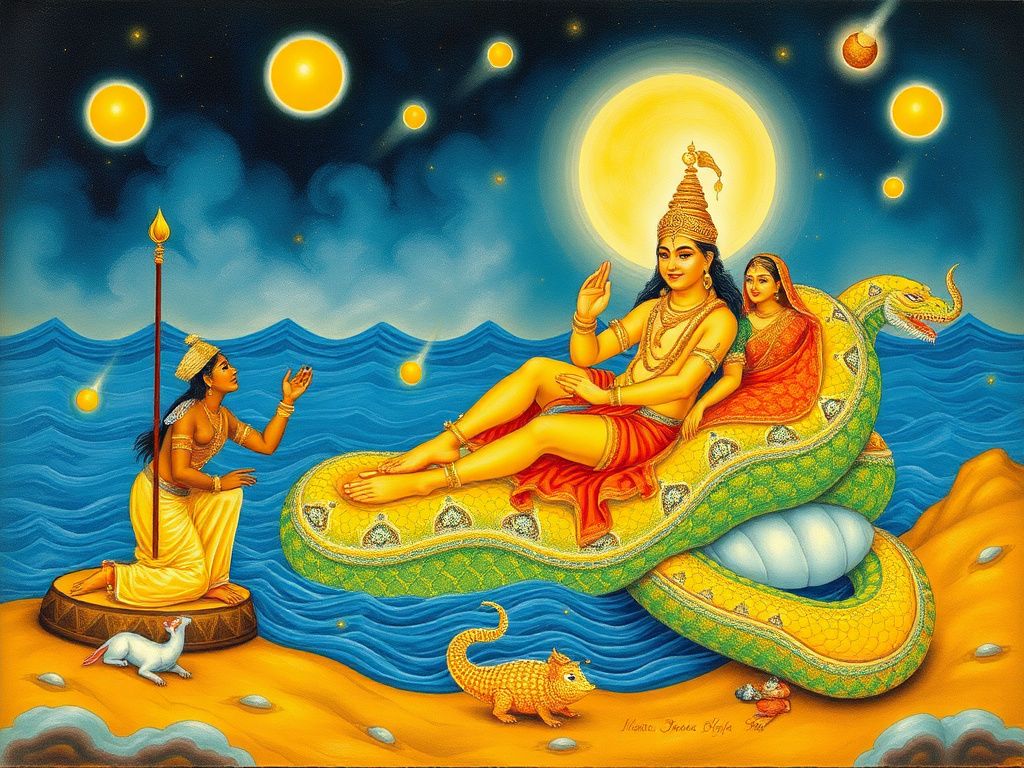
The pilgrimage to Tirumala begins, in the deepest sense, with an episode that took place in a divine assembly on the banks of the Ganga, when a question was raised among sages about which of the Trimurti (Brahma, Vishnu, or Shiva) is supreme. To answer it, the sages chose Sage Bhrigu to conduct a test. What followed changed the course of the entire Tirumala story, setting in motion a chain of events whose endpoint is the presence of Lord Venkateswara on the Seven Hills. For pilgrims who wish to understand why the Lord is at Tirumala at all, this is the episode to understand first.
Table of Contents
The context: a yajna and an urgent question
Long ago, a gathering of great sages was performing a grand yajna (sacred fire sacrifice) on the banks of the Ganga. A serious disagreement arose: to which of the Trimurti should the fruits of the yajna be dedicated? The sages chose Sage Bhrigu to settle the matter. Bhrigu was known for his fierce, probing nature, a sage willing to act in ways that ordinary devotion would forbid in order to arrive at truth.
The test of the three deities
Bhrigu approached Lord Brahma first and found the creator-god absorbed in his own processes, unwelcoming and inattentive. He proceeded to Lord Shiva next and found a similarly poor reception. Finally, he arrived before Lord Vishnu, resting on the serpent Adisesha in Vaikuntam. Committed to testing the Lord fully, Bhrigu walked up and kicked him firmly on the chest.
Vishnu’s response and the conclusion
Lord Vishnu rose immediately, but his first concern was not for himself. Had Bhrigu’s foot been hurt by striking his hard chest? He began to gently press and soothe the sage’s foot, expressing concern for any pain caused. This response, calm, compassionate, and completely without ego, demonstrated a greatness that no display of power could have conveyed. Bhrigu, himself a sage of the highest order, recognised it at once and declared that Vishnu is the supreme deity to whom the yajna’s fruits should be offered.
The departure of Goddess Lakshmi
The test had a consequence that Bhrigu had not fully anticipated. Goddess Lakshmi (Sridevi) dwells eternally on Vishnu’s chest. The kick from Bhrigu had landed on her dwelling place, and she had felt its force. But what wounded her more deeply was that the Lord, rather than defending the honour of the chest she inhabits, had turned his concern toward the one who kicked it. Feeling that her place had been dishonoured without adequate response, Lakshmi left Vishnu’s presence and descended to Earth. In the Tirumala tradition, her departure is the pivotal turning point that begins the Lord’s search.
How this episode leads to Tirumala
Bereft of Lakshmi, Lord Vishnu left Vaikuntam and came to Earth in search of her. His journey brought him to the sacred Seven Hills of Tirumala, where he took up residence in an ant-hill and performed penance. This begins the Tirumala Sthala Purana proper: the encounter with Padmavathi, the divine courtship, the wedding, the debt to Kubera, and the Lord’s decision to remain at Tirumala in permanent vigil until the debt is repaid by the offerings of devotees. Every pilgrimage and every offering at the hundi traces back to the departure of Lakshmi.
The deeper meaning
- Supremacy through humility: The test reveals that Vishnu’s greatness lies not in power or retaliation but in compassion and the complete absence of ego
- The Srivatsa mark: The mark on the Lord’s chest at Tirumala is traditionally associated with this episode, marking the site of Lakshmi’s dwelling
- Lakshmi’s return: The entire Tirumala narrative is, at its core, about the divine couple’s eventual reunion through the medium of Padmavathi and the devotion of pilgrims
- Why devotees give: The chain from Bhrigu’s kick to the wedding to Kubera’s loan explains why donations at Tirumala carry the specific significance they do
If you ask me, the Bhrigu episode is the most illuminating lens through which to understand Tirumala, because it shows that the Lord is here not as an act of power but as an act of love and searching, which changes the character of what it means to come here as a pilgrim.
Scriptural basis
The Bhrigu episode is recorded in Puranic literature and is central to the Tirumala Sthala Purana tradition as maintained by TTD. One limitation to be straight about: different Puranic texts narrate aspects of this story with variations in detail, and scholars note textual differences across sources. The version described here follows the tradition as understood in the context of the Tirumala pilgrimage. For authoritative accounts, refer to tirumala.org or TTD’s own publications on the Sthala Purana.
Common questions
Why did Bhrigu kick Vishnu? To test the Lord’s response and determine which of the Trimurti is truly supreme and worthy of a yajna’s offerings. Bhrigu chose the most provocative test he could devise.
Why did Goddess Lakshmi leave? She was offended that her dwelling place (Vishnu’s chest) was kicked and that the Lord, rather than punishing the offender, showed him kindness. She felt dishonoured by his response and left.
How does this connect to Tirumala? Vishnu’s search for the departed Lakshmi brought him to the Seven Hills of Tirumala, where he began the penance and the story that eventually results in his permanent presence as Sri Venkateswara.
Who is Bhrigu? One of the saptarishis (seven great sages) in Hindu tradition, known for his fierce, testing, and unsparing nature. He appears across multiple Puranic texts as a figure who challenges even the gods.
Is this story in the scriptures? Yes. The Bhrigu episode appears in Puranic literature and forms the prelude to the Tirumala Sthala Purana in the tradition maintained at the temple.
What is the Srivatsa mark? A mark on the Lord’s chest traditionally associated with Lakshmi’s dwelling and, in some accounts, with this episode of the kick. It is one of the identifying signs of Vishnu.
How does the Bhrigu story explain donations at Tirumala? Because Vishnu borrowed money from Kubera to fund his wedding to Padmavathi, pilgrims’ offerings at the hundi are understood as contributions toward repaying that divine debt, a chain of causation that begins with the Bhrigu episode.
Related reading
- Sthala Puranam of Tirumala: The Complete Origin Story
- Why Lord Vishnu Descended to Tirumala
- Sri Padmavathi Ammavari Temple