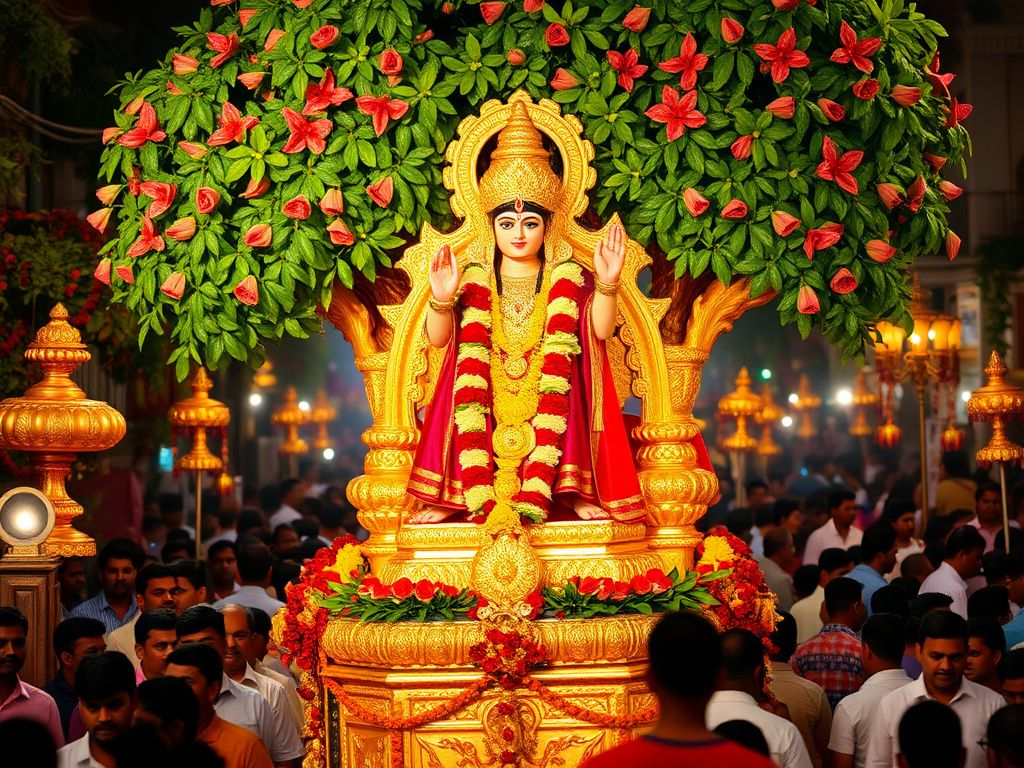
Among the sixteen vahana sevas of the Tirumala Brahmotsavam, the Kalpavruksha Vahanam carries one of the most heart-warming meanings in the entire festival sequence. The Lord is borne on a vehicle representing the Kalpavruksha, the divine wish-fulfilling tree of the heavens, and by mounting this vahanam, Lord Venkateswara declares Himself the true and inexhaustible source who fulfils the prayers of all who take refuge in Him.
Table of Contents
What is the Kalpavruksha
In Hindu tradition, the Kalpavruksha (also called Kalpataru) is the celestial wish-granting tree said to have emerged during the churning of the cosmic ocean, the Samudra Manthana. Any wish made sincerely beneath its branches is said to be granted. The Kalpavruksha symbolises divine abundance, generosity, and boundless grace — a grace that asks for nothing in return from the seeker.
The concept appears across Puranic literature as one of the five divine trees of Svarga (heaven), alongside Parijata, Mandara, Harichandan, and Santana. Of these, the Kalpavruksha is most commonly invoked in devotional contexts because of its direct association with desire-fulfilment and refuge.
The symbolism for devotees
When Lord Venkateswara rides the Kalpavruksha Vahanam, the symbolic message is layered and direct:
- Infinite generosity: The Lord, like the wish-tree, gives endlessly to His devotees without diminishing.
- Fulfilment of desires: Devotees pray that their sincere wishes be granted as if standing beneath the divine tree itself.
- The higher teaching: The greatest wish the Kalpavruksha can grant is the Lord Himself: liberation and union with the divine, which surpasses all material desires.
- Refuge: Just as travellers seek rest under a tree’s shade, devotees find shelter from the difficulties of life in the Lord’s grace.
For what it’s worth, this is one of the few vahana sevas where the vehicle’s symbolic meaning feels genuinely accessible to anyone regardless of their depth of scriptural knowledge — the idea of a wish-fulfilling tree is immediately understood and deeply felt.
Place in the Brahmotsavam sequence
The Kalpavruksha Vahanam is one of the processions carried along the four mada streets surrounding the Tirumala temple during Brahmotsavam. The processional deity, Lord Malayappa Swamy, is richly adorned and placed on the beautifully decorated tree-vehicle, then taken in procession amid Vedic chanting, nadaswaram, and devotional music. The atmosphere in the streets is one of collective reverence, with devotees lining the procession route from early in the evening.
The Brahmotsavam at Tirumala is celebrated twice in 2026: 15-23 September 2026 (Salakatla) and 12-20 October 2026 (Navaratri, Adhika Masa). The exact day and timing of the Kalpavruksha Vahanam within each festival should be confirmed closer to the date via news.tirumala.org.
How to witness the procession
The vahana processions are held in the public mada streets surrounding the main temple and are free for all devotees. No ticket or booking is required to stand along the route. That said, popular vahana days draw very large crowds, and finding a clear viewing position along the mada streets requires arriving well ahead of the scheduled procession time.
- The procession is free for all devotees along the mada streets.
- Arriving one to two hours early is generally advisable for a reasonable viewing position.
- Premium arati viewing may be available via advance Arjitha Seva booking; check ttdsevaonline.com for current booking options.
- The streets can become very crowded; those with mobility concerns or young children should plan accordingly.
One honest caveat: TTD does not always publish the exact vahana-by-day schedule far in advance, so the specific evening on which the Kalpavruksha Vahanam falls may only become clear a few days before the festival begins. Check news.tirumala.org as the festival approaches for the confirmed schedule.
The Kalpavruksha and the devotional tradition
The Kalpavruksha Vahanam connects directly to one of the oldest devotional instincts: the desire to bring one’s wishes before the Lord and trust that they will be heard. Pilgrims who come to Tirumala carry with them prayers for health, family, livelihood, and liberation. The vahana that represents a tree granting every sincere desire is, in this context, not merely a decorative vehicle but a theological statement about the nature of Lord Venkateswara’s grace.
This is also why so many devotees are particularly moved watching this procession. The Kalpavruksha is not an obscure symbol requiring explanation; it speaks directly to the human experience of longing and hope, and to the belief that a sincere prayer is never offered into emptiness.
Common questions
What does Kalpavruksha mean? The divine wish-fulfilling tree of the heavens. In Sanskrit, kalpa conveys the sense of fulfilling all desires, and vriksha means tree.
Where did the Kalpavruksha originate? It emerged during the churning of the cosmic ocean (Samudra Manthana) and is counted among the divine trees of Svarga.
What is the central lesson of this vahanam? That Lord Venkateswara is the true, inexhaustible source of all fulfilment, and the highest wish He grants is union with the divine itself.
Do I need a ticket to watch the procession? No. Vahana processions in the mada streets are free for all devotees.
When is the 2026 Brahmotsavam? 15-23 September 2026 (Salakatla) and 12-20 October 2026 (Navaratri, Adhika Masa).
How do I find out which day the Kalpavruksha Vahanam falls on? Check the official schedule on news.tirumala.org as the festival date approaches, since day-by-day vahana assignments are typically published close to the event.
Can I book a special arati viewing for this procession? Premium viewing for certain sevas may be available via Arjitha Seva booking on ttdsevaonline.com; availability changes each year.
Related reading
- Kalpavruksha Vahanam (existing overview)
- Sarvabhupala Vahanam at Tirumala
- Garuda Vahanam, Day 5
- Tirumala Festival Calendar 2026